
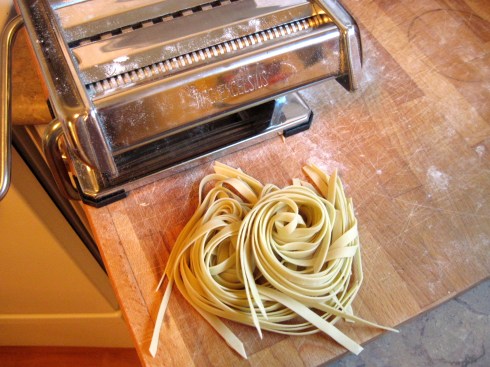
 Recently I was lucky enough to receive a pasta machine from a relative (thanks Cecilia!), and I’ve been giving it a pretty good workout lately – it definitely makes homemade pasta easier to churn out than rolling it by hand. This particular pasta machine was made in Italy but comes under the name “NUDELMASCHINE”, which sounds more German than Italian and prompts me and Nate to put on our best/worst German accents whenever it comes out of the cupboard for a pasta-making session.

A little while ago I came across a recipe for sourdough pasta on The Gingered Whisk (one of my Sourdough Surprises buddies), and as recipes for using up excess sourdough starter are always useful, I gave it a whirl. Like all things made with my particular sourdough starter, the sourdough taste in the pasta was not very assertive (I think I must have a very mild culture in my starter) but I get a kick out of using my starter wherever I can. For the pasta in this post, I doubled my original homemade pasta recipe and added about 1/4 cup excess starter to the dough. It made a really nice, silky, easy to work with dough that I happily ran through the pasta machine and then coiled into little nests under a tea towel.

Unfortunately, this pasta is moister than I’m used to, and by the time I’d finished cutting the last of it into strands of fettuccine, those little nests of pasta had stuck together beyond the point of possible separation and the individual strands of pasta were no longer so individual.

I swore a bit (OK, a lot), then had no choice but to run it all through the pasta machine again. This time, instead of coiling the finished pasta into nests, I hung it to dry on a broomstick balanced between two chairs, which worked like a charm.

So this pain-in-the-butt actually had a happy ending, because I learned two things: one, if you are letting the fresh pasta sit for any length of time before cooking it, the drying step is crucial; and two, this dough can tolerate being man-handled rather a lot, and in fact I would recommend it – when cooked, the pasta was silky yet chewy in just the right way, and probably the best I’ve made yet. Also, drying the pasta out allows you to keep it in the fridge for a few days in a sealed Ziplock bag, which is great because this recipe made enough for two meals for me and Nate.
Sourdough Pasta
Makes 1 lb of pasta, enough for about 4 servings. If you are rolling this by hand without a pasta machine, be sure to give the dough a thorough kneading to encourage gluten formation before rolling it out – it should be very smooth and elastic.
In a medium bowl, measure:
2 cups all purpose flour
In a small bowl or cup, whisk together:
2 eggs
1 – 2 tbsp olive oil
Pour the egg mixture into the flour, then add:
1/4 cup sourdough starter (does not have to be active – discard is fine)

With a fork, mix the liquid into the flour, starting in the middle and gradually drawing in the flour from the edges of the bowl. Add water, a few drops at a time as needed, to form a shaggy dough.

Turn the dough out onto a lightly floured surface and knead it with your hands until it becomes a cohesive, smooth dough. Cover the dough with the upturned bowl and let it rest for 20 – 30 minutes.

When the dough has rested, cut it into 4 pieces. Flatten one of the pieces into a long-ish shape, dust it with flour, and pass it through the pasta machine’s flat rollers at the widest setting. Fold the dough in thirds and pass through the rollers again. Repeat about 6 more times or until the dough is very smooth and elastic, folding the dough in half or thirds after each pass and flouring it as necessary to keep it from sticking. Don’t worry about overdoing this stage – you are essentially kneading the dough with each pass and the more passes you make, the stronger the gluten in the dough, which means nice chewy pasta rather than limp, flabby pasta.

Turn the rollers to their next smallest setting and pass the dough through about 3 times, folding it in half on the first pass if you feel it necessary. Continue this way, with 2 or 3 passes at each setting (without folding) before moving onto the next smallest setting. Feel free to cut the pasta sheet in half it it gets too long to handle easily. If you are making long pasta sheets for lasagne, continue on to the very smallest setting. If you are making cut pasta (ie, fettuccine), stop at the second-to-smallest setting. Repeat with the remaining pieces of pasta dough.

At this point, I cut the pasta sheet in half and fed it through the fettuccine cutter. As it comes out the other side in strands, catch it on the handle of a wooden spoon (this does a better job than your hands of keeping the strands more or less separate). Transfer the cut pasta to a drying rack, aka a broomstick handle balanced between two chairs, making sure that the strands are not overlapping or they will stick together in the time it takes you to cut the rest of the pasta.

If you are cooking the pasta immediately, you don’t need to dry it out any further – just drop it in rapidly boiling, salted water for 3 – 4 minutes, until al dente. If you want to store the raw pasta for a few days, make sure it is quite dry (no chance of it sticking together) and place it in a Ziplock bag in the fridge. The drier pasta may take a few more minutes to cook.

This post submitted to YeastSpotting.



 Korena in the Kitchen
Leave a reply to frugalfeeding Cancel reply