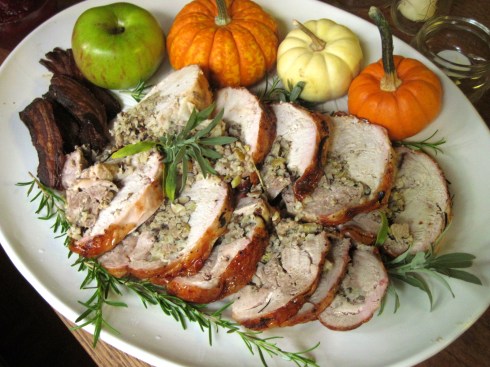
Last weekend was Canadian Thanksgiving, which meant turkey, turkey, turkey (I finally froze the leftovers because I just couldn’t face them any more!). We hosted my parents for dinner and again, I cooked the turkey… but not just any turkey. This year, I took the opportunity cross an item off The List by de-boning*, stuffing, and rolling the turkey. The results were amazing!
While the prep for a de-boned, stuffed, and rolled turkey is a little more time consuming than a regular stuffed bird (it took me forty-five minutes to de-bone it, and another thirty minutes to stuff, roll, and truss it), it pays off in ease of cooking. No estimating cooking times based on weight/stuffed/unstuffed/previously frozen/fresh, etc – just two to two-and-a-half hours! No basting! No specialty gigantic unwieldy roasting pan!

Because the turkey is essentially transformed into a long cylinder, it cooks evenly and the breast meat stays as moist as the dark meat. Draping it in bacon just takes it over the top. Did I mention that it tastes INCREDIBLE?!

Cooking it like this also makes for super easy carving: just cut it into slices, and everyone gets a good mix of white and dark meat, crispy skin, and stuffing. So, so delicious. I made an apple cider gravy to go with it (inspired by this one) and this was the best turkey dinner we’ve ever had, hands down! If your traditional roast turkey dinner needs a bit of sprucing up, I highly recommend this method!

*I realize that the Grammar Police might take issue with my use of “de-bone” when the proper word is probably “bone”, but telling people, “I boned a turkey at Thanksgiving!” gives them an entirely different idea of what happened… 😉

- Warning: this post contains lots of pictures of me manhandling a raw turkey. If you are squeamish or a vegetarian, you might want to avert your eyes.
De-Boned, Stuffed, Rolled Turkey
Method from Martha Stewart. Serves about 10 people.
De-Boning
Give yourself plenty of time to do this, especially on the first try – at least an hour. I’m fairly familiar with poultry anatomy so I had a good idea of what I was doing, but it does require some time.
For the de-boning process, you will need:
a 12 – 14 lb turkey, skin patted dry with paper towels (any larger and you will have trouble fitting it onto a baking sheet)
a large piece of butcher paper or parchment paper (butcher paper is better because it won’t disintegrate with the moisture from the turkey)
a long, thin knife with a very sharp flexible blade (I used a fish fileting knife)
some clean, dry cloths
a large bowl or pot for the turkey carcass and bones (great for turkey stock!)
Before you start, watch this video a few times to get the gist of the process. The goal is to remove all the meat from the carcass with the skin intact.
Place the butcher paper in the middle of your work surface. Place the turkey on the paper, breast down with the tail end towards you. With your knife, cut through the skin to the bone along one side of the backbone.

Using the tip of your knife, cut the flesh away from the ribs down towards the breast bone, being careful not to break the skin. Cut down towards the tail end of the turkey until you reach the ball-and socket-hip joint, where the thigh meets the body. Pop the joint to separate the leg and thigh from the carcass.

With the tip of your knife, find the shoulder joint where the wing meets the body, and again, pop it out.

(Pro tip: cut on the outside of the wishbone, otherwise you will never find the shoulder joint and won’t actually separate the carcass out of the turkey, and you will wonder what the hell is wrong with this turkey’s anatomy.)

Repeat on the other side of the turkey, then completely remove the carcass by cutting the breast meat from both sides of the cartilagenous keel bone. Be careful not to cut through the skin of the breast.

To remove the leg bones, cut through the meat of the thigh and drumstick to expose the bone.

With the tip of your knife, cut and scrape out the hip end of the thigh bone, then continue scraping the meat off it until it comes free. Discard it in your bone bowl.

Repeat with the drumstick, cutting through the skin and tendons at the tip of the drumstick to free the bone.

Now comes the tedious part: removing the leg tendons, which is essential because they won’t break down with cooking and would be really unpleasant to bite into.

With a dry cloth, grasp the ends of the tendons and use your knife to scrape the meat off of them, until they pull free of the meat. Repeat until all the tendons are removed from the leg – I didn’t count, but there’s probably about 10 tendons per leg to remove. Repeat on the other leg.

To de-bone the wings, cut off each wing at the second joint (the “elbow”) and discard into your bone pot (they will make excellent stock).

Use the tip of your knife to expose the shoulder end of the remaining wing bone, so that you can grip it with your fingers, and use the knife to scrape the meat off the bone and pull it free of the flesh. Repeat on the other side.

Congratulations, you just de-boned a turkey!

Stuffing and Rolling
To stuff and roll the turkey, you will need:
5 – 6 cups of stuffing, preferably one that will hold together quite well. I used my Mum’s wild rice and sausage stuffing and added a few eggs to the mix to bind it together. That recipe calls for the sausage to be cooked and crumbled, but it would have been better if I had left the sausage raw because then it would have cooked into a cohesive sausage inside the turkey, rather than threatening to crumble when I cut it into slices.
8 – 10 pieces of butcher’s twine about 12″ long, plus 1 very long piece
4 – 5 sprigs each of sage and rosemary
4 – 5 slices of bacon, cut in half lengthwise
Flip the breast tenderloins down to cover the bare skin between breast and thigh, and bring the legs close together to cover the space between them. Use your knife to sort of butterfly any thicker bits of meat to make the layer of meat over skin relatively even.

Season the meat with salt and pepper, then place the stuffing down the middle of the turkey, pressing it into a cylinder.

Roll up the turkey to enclose the filling, using the butcher paper to help you roll. The extra skin from the neck of the turkey should wrap around to cover the bare spot between the legs. Rolling was probably the most difficult part because the stuffing desperately wanted to escape, so I used some toothpicks to secure it closed while I trussed it up with string.

Turn it seam-side down and tuck in the ends. Slide a piece of string under one end and tie it tightly to secure. Tie several more strings, each about an inch or so apart, down the length of the turkey. You want the roll to be mostly uniform in diameter. If you feel it needs more security, tie one long string lengthwise, weaving it between the cross strings to hold it in place.

Roll the turkey onto a rack set on a large baking sheet, curving it as necessary to fit it onto the sheet. Drizzle with olive oil and rub it all over the skin, then season with salt and pepper. Drape the pieces of bacon over the roll, then tuck the sage and rosemary sprigs under the string, between the bacon.

Cooking and Serving
Roast the turkey roll at 375˚F for 2 – 2 1/2 hours, until well browned and the internal temperature registers 165˚F on a thermometer. About 10 minutes before mine came out of the oven, I brushed it with a mixture of 2 tbsp maple syrup + 2 tbsp apple cider for some extra flavour (not that it really needed it!).

Remove the turkey from the oven and tent with foil to rest at least 10 minutes (mine rested for closer to 30 minutes). Cut off the strings, discard the herb springs, and remove the bacon to a serving platter. Cut the turkey roll into 1/2″ – 3/4″ thick slices and place on the serving platter. Serve with gravy made from the pan drippings.


 Korena in the Kitchen
Leave a comment