What does your family eat for dessert at Christmas dinner? In my family, our Christmas dessert for years and years was the traditional steamed Christmas pudding, served a-flame; however a few Christmases ago, we all admitted to ourselves that the only thing we really liked about Christmas pudding (other than setting it on fire) was the hard sauce that came with it. So, it was time for a new Christmas dessert. And dessert, in my family, is generally my department.
I cast about the internet and searched through my cookbook and magazine collection for a replacement dessert, and over the past few years I’ve made a few different things. On year it was poached pears with gingerbread (it had potential, but the pears were undercooked), and for two years now I’ve made a Yule Log (sometimes called a Bûche de Noël) – a sponge cake rolled around some kind of filling and decorated to look like a chunk of wood. I like it because it’s traditional in the same way a Christmas pudding is traditional, but not stodgy and infinitely variable. I also like the acknowledgment, however slight, of a winter festival that doesn’t include a fat man dressed in red or a baby born in a manger.
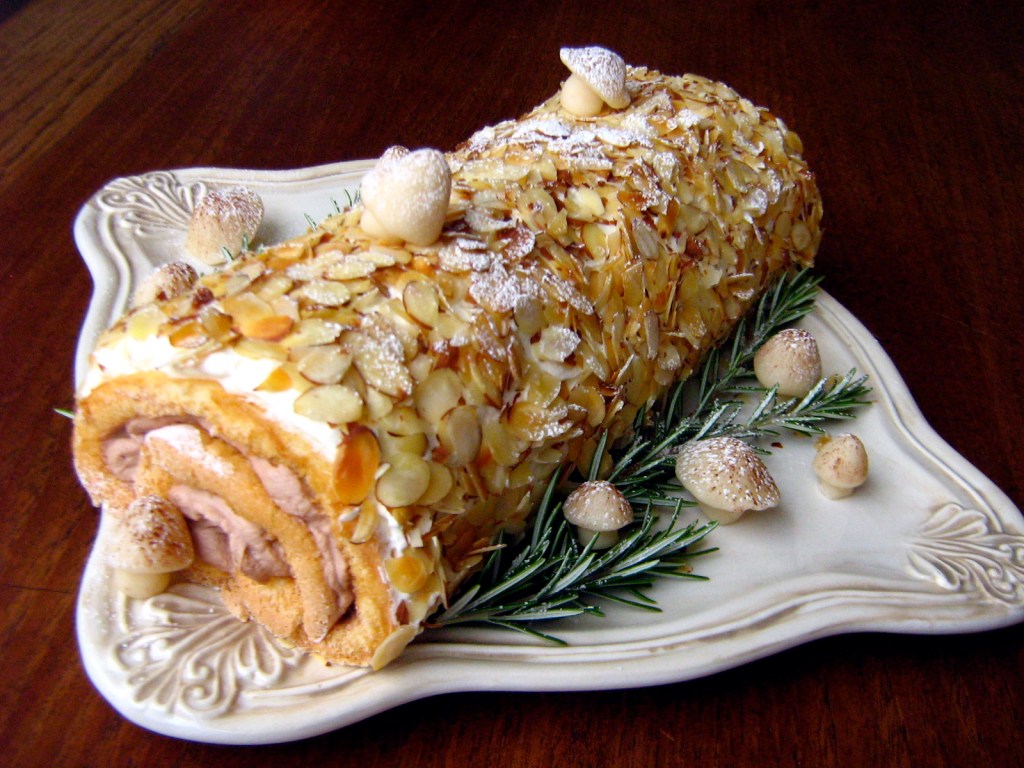
I made this Yule Log to take to Nate’s parents for Christmas dinner this year. When I read the words “chocolate hazelnut spread” in the recipe, I was sold. I am a big fan of Nutella. BIG. And I’m a pretty big fan of this cake, as it turns out (we all were, actually!). It was light, creamy, and a great way to end a big turkey dinner. The almond sponge cake is subtly flavoured and nice and moist, and the whipped cream-Nutella filling is airy and creamy. And damn, are those marzipan mushrooms ever cute! (And totally optional if you don’t like cute food or marzipan .)
The only change I would make is to sprinkle on the sliced almonds just before serving, as they lost most of their crunch overnight in the fridge. Otherwise, it was really really good and I can think of a ton of ways to vary the flavours: chocolate sponge with whipped cream and cherries for a Black Forest Yule Log? Dulche de Leche instead of Nutella? Perhaps some citrus in the sponge cake?…
Too bad Christmas dessert only happens once a year!
Chocolate Hazelnut & Almond Yule Log
Adapted ever-so-slightly from my trusted friend Martha. Serves 8-10.
Almond Sponge Cake
Preheat the oven to 350˚F and prepare a 10″ x 15″ jellyroll pan by spraying it with cooking spray, lining the bottom with parchment paper, and spraying the paper with more cooking spray. Set aside.
In a large bowl, combine:
4 egg yolks (keep the whites – you’ll use them in a minute)
1/2 cup granulated sugar
Whisk until pale and thickened. Whisk in:
1/4 tsp almond extract
1/4 tsp vanilla
Add:
1/2 cup all purpose flour
Whisk until just combined – don’t over-mix. Set aside.
In a mixer bowl with the whisk attachment, combine:
4 egg whites
1/4 tsp salt
Beat until soft peaks form. Gradually add:
1/4 cup granulated sugar
Continue beating until stiff, glossy peaks form.
Whisk 1/3 of the egg whites into the egg yolk mixture to lighten it, then with a rubber spatula, carefully fold the rest of the egg whites into the batter – you want to combine it without completely deflating it.
Pour the batter onto the prepared pan and spread it out evenly.
Bake at 350˚F for 15-17 minutes, until lightly golden brown and the center of the cakes springs back when lightly pressed (I swear I took a picture of this stage, but my camera must have eaten it!). Immediately run a knife around the edge of the cake to loosen it from the pan, dust the cake with icing sugar, and invert it onto a sheet of parchment. Peel off the lining paper that is now on the top of the cake, and starting from the short end, roll the cake with the clean parchment paper into a cylinder. Let it cool completely, seam side down.
The whipped cream filling and frosting are stabilized with gelatin, which does not turn them into Jell-o, but rather prevents them from getting runny and also gives them a fluffy, mousse-like texture.
In a small saucepan, combine:
2 tbsp water
1 tsp unflavoured gelatin
Set aside to soften for a few minutes.
Meanwhile, in a medium bowl, mix together:
1/4 cup chocolate hazelnut spread, such as Nutella
1/4 cup whipping cream
Set aside.
Over low heat, warm up the gelatin mixture until it dissolves, then set aside to cool.
In a mixer bowl with the whisk attachment, combine:
2 cups whipping cream
1/4 cup granulated sugar
Beat until soft peaks form, then beat in the gelatin mixture all at once.
Fold a little more than half the whipped cream into the chocolate hazelnut mixture to make the filling. The remaining plain whipped cream is the frosting.
To Assemble
Unroll the cooled sponge cake and spread it with the chocolate hazelnut filling, leaving a 1/2 inch border at the edges. Roll it up again from the short end, this time without the parchment paper.
Transfer the cake roll carefully to a serving platter. I found it easiest to lift it onto the plate using the parchment paper, then carefully slide it off the parchment onto the platter. Protect the platter with strips of waxed paper tucked under the cake, then spread the outside of the cake with the plain whipped cream. Cover it lightly with plastic wrap and refrigerate for at least 2 hours or overnight. Just before serving, sprinkle with 1 cup toasted sliced almonds. Martha suggests slicing off the ends of the cake to reveal a cleaner cross-section of the inside of the roll, but I left it rustic. Decorate with marzipan mushrooms and rosemary foliage. Sprinkle with a light dusting of icing sugar “snow” and cut into slices to serve.
Marzipan Mushrooms
Roll a chunk of marzipan into a 3/4 inch ball. Cut about 1/3 off of the ball. Shape the large bit into a mushroom cap, and roll the smaller bit into a mushroom stem with a tapered point at one end. With the tip of a knife, bore a little hole in the underside of the mushroom cap; squish the tapered end of the mushroom stem into the hole to attach it (use a bit of water to make it sticky if necessary).
Place on a plate, dust very lightly with cocoa powder, and leave uncovered to harden a bit.
Store in an airtight container at room temperature. I used a little less than 100 grams (~3 oz) of marzipan to make about a dozen mushrooms.
Our Daring Bakers Host for December 2011 was Jessica of My Recipe Project and she showed us how fun it is to create Sour Dough bread in our own kitchens! She provided us with Sour Dough recipes from Bread Matters by AndrewWhitley as well as delicious recipes to use our Sour Dough bread in from Tonia George’s Things on Toast and Canteen’s Great British Food!
Well. This was QUITE the exhaustive challenge! Not only making bread, but actually cultivating the natural yeasty-beasties that turn it from flour-and-water-glop to bread, and then creating an edible to showcase said bread. See, exhaustive.
Sourdough bread begins with a “starter”, which is essentially a mixture of flour and water left long enough to get all bubbly and alive. Yes, alive – those little yeasties in the starter are living and need to be fed their own weight in flour and water in order to stay lively enough to make bread rise. When I began this challenge, I thought that making a starter involved catching wild yeast from the air (does that sound crazy?), but it turns out that the yeasts in question are actually on the grains that the flour is made from, and the flour-water mixture just wakes them up to they can do their yeasty thang. For this reason, whole, organic grains are best for making a starter: less processing equals more natural yeast in the flour, which means a more active and effective starter. You can turn a whole grain starter into a white flour starter (which is a little more versatile) by simply feeding it white flour after it has been established.
If you’ve been following along, you might have deduced that the starter grows in size with every feeding. Because of this, you either need to bake with the excess or discard some of the starter before every feeding, otherwise you’d end up with a monster starter that would demand increasingly huge amounts of flour and water. If you are planning on doing some baking, the extra starter is what you use to make bread, crumpets, pancakes, cakes, etc – the key is always saving a bit of starter to keep feeding for next time. Over time, the flavour of the starter develops and it becomes more active. This is how some starters manage to last for hundreds of years (provided their caretakers remember to feed them!), the extra passed on from person to person, taking on different characteristics depending on the flours used, but ultimately all from one “mother batch” of starter – for example, Carl Griffith’s 1847 Oregon Trail starter, which can be ordered online and has been kept alive for over 160 years!
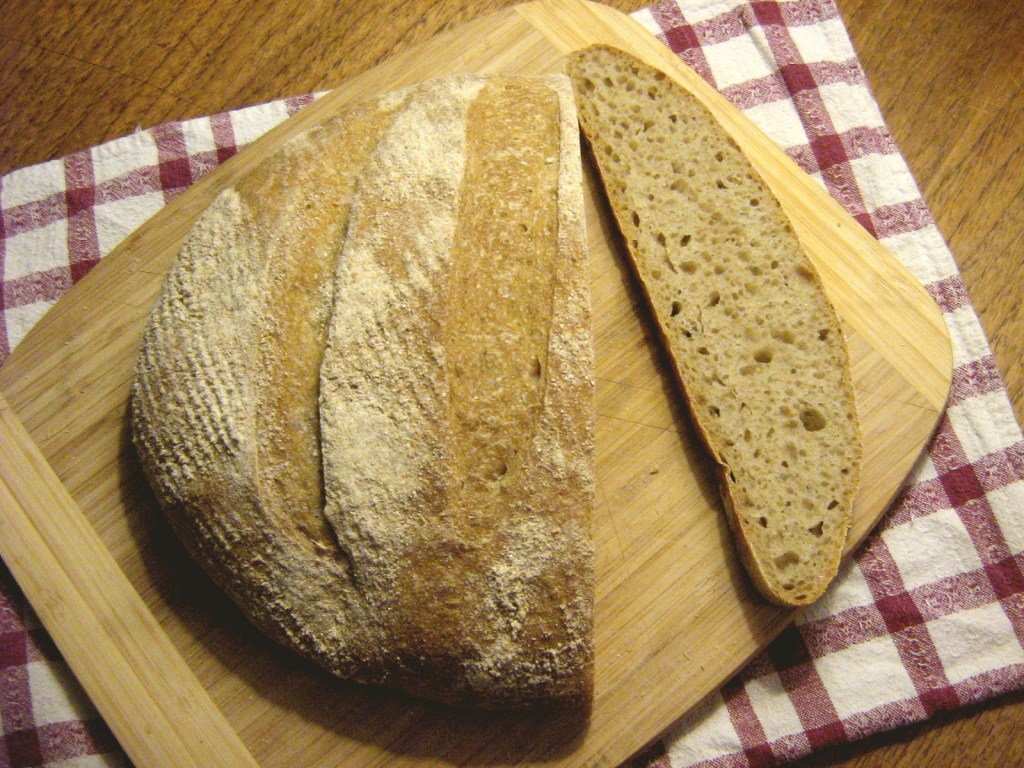
When I think of sourdough, I think of San Fransisco-style sourdough – dense and chewy with a pronounced sour tang. However, this is not the case with all sourdough, aka natural starter, breads - that sour taste is just one of many flavour nuances that can be possible with a natural starter. The taste has to do with the age of the starter used and the different kinds of microorganisms living in it, which can vary by region and flour type – hence the sourness of San Fransisco sourdough versus the subtle fermented flavour of a rustic French natural starter bread. This French Country Bread falls into the former category of subtle fermentation: it was made with a very new starter, but still had a nice flavour – not sour, but delicious. And it will only get better as the starter ages . Another great thing about this bread was the texture: it had an open, airy crumb, which is desirable in a rustic European style bread, and a slightly waxy texture, which is the mark of a good sourdough, apparently!
Jessica, our host, gave fantastic instructions for making this loaf, from starter onwards, including some very helpful instructional videos. Because her instructions were so great, I’m going to post them here basically as written, with a few of my own notes added. Such as: this is a VERY WET dough and it’s supposed to be that way. The best way to deal with it and stop it from sticking to every part of you is to use wet hands rather than extra flour. Also, because of how wet it is, it will spread out into a flattish loaf – but again, this is how it is supposed to be!
Notes from Jessica on bread making:
Good bread starts with good flour. Beyond trying to find good quality, local (organic if possible) flour, Whitley recommends finding out three things: how was it milled? (stoneground ideally, to retain more nutrients); how much of the original grain is left in the flour (ideally 95-100 % for bread making); and lastly, how much protein is in the flour? (the more protein, the more gluten, leading to a more stretchy dough – ‘strong’ or ‘bread’ flour indicates a higher level of protein).
Normal tap water in the starter and bread is fine in most cases, unless you live in a municipality that heavily chlorinates the water. Chlorine will kill almost all bacteria, including your yeast, so you’ll want to use filtered water if you can. Whitley says that leaving water in a pitcher overnight can rid most of the chlorine.
If you clean your kitchen with anti-bacterial products or harsh cleaners, try not to do it before baking and make sure your bowls are clean but have no chemical residue left on them! Many a bread has been deflated by an overly-sterilised kitchen.
The recipe calls for sea salt because it retains a higher level of minerals and has a stronger salt taste, meaning you can use less of it. Never add salt directly to your starter – it will kill the yeast, so use the following method: dissolve your starter in water, stir your salt through your flour, then mix the wet with the dry ingredients.
When working with the dough, you might feel inclined to heavily flour your work surface or your hands. Resist this urge! Sourdough is meant to be wet and sticky – this helps to give the bread a nice crumb once it has baked. Most doughs can be worked by hand, but sometimes a dough scraper is used to help lift and fold the dough. To pick up or shape a loaf, damp hands work better than floured ones!
If you don’t have dough scrapers, old bank cards/credit cards work just as well! But wash them thoroughly first.
Try to work with your hands to make these recipes – mixing and kneading the dough by hand means you’ll get a better sense of how your dough should feel! We learn by doing!
Remember, a lot of these timings are guidelines – pay attention as, depending on temperature and your starter, you may need more or less time to proof your dough. You want a dough that resists poking a bit (if you poke it, the hole will disappear) but not one that quivers all over and seems really fragile.
Timing: for the French Country Bread, refresh the starter in the morning, make the final dough at lunchtime, and bake at dinner time.
Notes on maintaining your starter:
Once you’ve finished baking, you’ll have some leftover starter. Keep this in a Tupperware container, as this is what you will use to start your next loaf (and so on…)! Some of the best starters are hundreds of years old – and they get better with time.
Feeding your starter: unless you are intentionally trying to build-up the amount of starter (for example, to use in a certain recipe), you want to discard about 2/3 of the starter before each feeding, otherwise it will triple in size every time you feed it. To feed, discard part of the starter and then add flour and water in equal parts by weight to the remaining starter (1:1:1 of starter:flour:water by weight, eg: 100 grams of each). The discarded starter is used to bake with (or can be passed on to a friend to keep). You can maintain your starter on several different schedules. If you bake daily, keep your starter at room temperature and feed daily. If you bake weekly, keep it in the fridge and feed it once a week (this is what I’m doing). You can also freeze starter if you bake very infrequently, but it does fine in the fridge so long as you feed it at least once a month – before you bake, simply refresh your starter according to the recipe – or feed it with equal parts by weight of flour and water – and let it come back to life at room temperature.
This whole grain wheat starter can be turned into a white starter by simply feeding it on white flour after it is established.
You might notice that your starter starts to smell a bit like acetone – this is completely normal. It may develop a grey liquid on top (called “hootch”!), which you can either pour off or stir back into the starter. To refresh the starter before baking, discard half of the original starter and add in fresh flour and water for the yeast to feed on.
Sometimes, very rarely, a starter might get moldy. This is often due to being left at room temperature without feeding. If there is a lot of mold throughout the starter, probably best to discard it. But the odd bit is not always a problem. It is nearly impossible to kill a starter, unless you get salt or chemical products in it – so don’t fret! Often it is just a matter of feeding it over a few days and nursing it back to life.
French Country Bread
Recipe from Bread Matters by Andrew Whitley. Makes 1 large loaf plus extra starter for your next baking project. The starter takes minimum 4 days to get going, and the bread takes about 12 hours (only about 1 hour active time).
The Starter
Day 1:
4 1/2 tablespoons (70 ml) (40 gm/1 ½ oz) stoneground breadmaking whole-wheat or graham flour 3 tablespoons (45 ml) water Total: scant ½ cup (115 ml) (3 oz/85 gm)
In a Tupperware or plastic container, mix the flour and water into a paste.
Set the lid on top gently, cover with a plastic bag, to prevent messes in case it grows more than expected!
Set somewhere warm (around 86 F if possible). Even if it’s not that warm, you’ll still get a starter going – it might just take longer. My house was definitely not that consistently warm and it worked fine.
Day 2:
4 1/2 tablespoons (70 ml) (40 gm/1 ½ oz) stoneground breadmaking whole-wheat or graham flour 3 tablespoons (45 ml) water scant 1/2 cup (115 ml) (3 oz/85 gm) starter from Day 1 Total: scant cup (230 ml) (6 oz/170 gm)
Stir the flour and water into the mixture from Day 1, cover, and return to its warm place. The mixture will be quite thick and stretchy.
Before feeding: a small amount of "hootch" and one tiny bubble. After feeding: thick and elastic-y.
Day 3:
4 1/2 tablespoons (70 ml) (40 gm/1 ½ oz) stoneground breadmaking whole-wheat or graham flour 4 teaspoons (20 ml) water scant 1 cup (230 ml) (6 oz/170 gm) starter from Day 2 Total: 1⅓ cup (320 ml) (230 gm/8-1/10 oz)
Stir the flour and water into the mixture from Day 2, cover, and return to its warm place. It will still be very thick and stretchy, and may be starting to smell sour/yeasty and/or look bubbly. Don’t worry if neither of these things happen!
Before feeding: two bubbles (!) and a yeasty smell. After feeding: quite thick and a little less stretchy.
Day 4:
3/4 cup plus 1½ tablespoons (205 ml) (120 gm/4 ¼ oz) unbleached all-purpose flour 1/2 cup less 4 teaspoons (100 ml) water 1⅓ cup (320 ml) (230 gm/8 oz) starter from Day 3 Total: scant 2⅔ cup (625 ml) (440 gm/15½ oz)
Stir the flour and water into the mixture from Day 3, cover, and return to its warm place. At this point it should be bubbling and smell yeasty. If not, repeat this process for a further day or so until it is! (You will have to discard some of the starter before each feeding if you continue feeding it on this daily schedule).
Before feeding, after feeding, and the next day (baking day) - it's alive!
The Bread
Stage 1: Refreshing the Leaven
1 cup less 1 tablespoon (225 ml) (160 gm/5 ⅔ oz) wheat starter 6 tablespoons less 1 teaspoon (85 ml) (50 gm/1¾ oz) stoneground bread making whole-wheat or graham flour 1 cup plus 2 teaspoons (250 ml) (150 gm/5 ⅓ oz) unbleached all purpose flour 1/2 cup (120 ml) water Production Leaven Total: 2¾ cups plus 4 teaspoons (680 ml) (480 gm /1 lb 1 oz)
Mix everything into a sloppy dough. It may be fairly stiff at this stage. Cover and set aside for 4 hours, until bubbling and expanded slightly. This mixture is called the production leaven.
Stage 2: Making the Final Dough
3/4 cup less 1 teaspoon (175 ml) (100 gm/3 ½ oz) stoneground breadmaking whole-wheat or graham flour, plus more for dusting 2 cups plus 2 tablespoons (510 ml) (300gm/10 ½ oz) unbleached all-purpose flour 1¼ teaspoons (7½ ml) (7 gm/¼ oz) sea salt or ⅔ teaspoon (3⅓ ml) (3 gm/⅛ oz) table salt 1 ¼ cups (300 ml) water 1 ¾ cups (425 ml) (300 gm/10 ½ oz) production leaven from Stage 1 (this should leave about 1 cup for your next loaf, which I added it back into my starter along with enough water to achieve the original consistency) Total: 6 cups less 2 tablespoons 1415 ml (1007 gm/35 ½ oz/2 lb 3½ oz)
Mix the dough with all the ingredients except the production leaven. It will be a soft, wet dough.Knead on an UNFLOURED surface for about 8-10 minutes, getting the tips of your fingers wet if you need to. You can use dough scrapers to stretch and fold the dough at this stage, or air knead if you prefer. Basically, you want to stretch the dough and fold it over itself repeatedly until you have a smoother, more elastic dough. See Jessica’s demonstration here:
Smooth your dough into a circle, then scoop your 1 3/4 cups production leaven into the centre. You want to fold the edges of the dough up to incorporate the leaven, but this might be a messy process. Knead for a couple minutes until the leaven is fully incorporated in the dough (at this point I could have added a little bit more flour to my dough). See Jessica’s demonstration here:
Spread some water on a clean bit of your work surface and lay the dough on top. Cover with an upturned bowl, lining the rim of the bowl with some water. Leave for an hour, so that the gluten can develop and the yeasts can begin to aerate the dough.Once your dough has rested, you can begin to stretch and fold it. Using wet hands and a dough scraper, stretch the dough away from you as far as you can without breaking it and fold it back in on itself. Repeat this in each direction, to the right, towards you, and to the left. This will help create a more “vertical” dough, ready for proofing. See Jessica’s demonstration here:
Heavily flour a banneton/proofing basket with whole wheat flour and rest your dough, seam side up, in the basket (I used a basket lined with a floured tea towel, but a bowl or colander would work too!). Put the basket in a large plastic bag, inflate it, and seal it. Set aside somewhere warm for 3-5 hours, or until it has expanded a fair bit. It is ready to bake when the dough responds to a gentle poke by slowly pressing back to shape.Preheat the oven to hot 425°F/220°C/gas mark 7. Line a baking sheet with parchment, then carefully invert the dough onto the sheet (put the baking sheet on top of the basket, then gently flip it over so as to disturb the dough as little as possible). Make 2-3 cuts on top of the loaf (a serrated bread knife works well for this) and bake for 10 minutes, then reduce the temperature to moderately hot 400°F/200°C/gas mark 6 and bake for an additional 30-40 minutes, until browned and crusty. The crust will appear rock hard when it first comes out of the oven, but will soften slightly upon cooling.Cool on a cooling rack, then slice and behold the beauty that is contained within. Large, irregular holes are the mark of a good artisan bread
Use the bread to make a delicious breakfast of a fried egg, sauteed mushrooms, and cheese sauce on toast .
Thanks Jessica for such a fun challenge and providing such great guidance! Also, Audax Artifex had some wonderful tips, as usual. I plan on keeping my little sourdough friend alive, so stay tuned for upcoming posts on ways to use sourdough starter! And be sure to check out the Daring Kitchen for all the other sourdough loaves this month
Merry Christmas! Here’s another way to enjoy some festive eggnog .
As I have previously mentioned, my first encounter with macarons was in Paris with my aunt when I was 18. I immediately fell in love, but I resigned myself to the fact that I would probably have to come back to Paris to ever taste them again, which would either be a) never, or b) a very very long time off. It never even occurred to me that I could make macarons at home – they seemed like some kind of impossibly complicated, intricate pastry that only the French could create – until I started noticing them popping up on food blogs a few years ago. However, it was also noted that the homemade macaron was a highly temperamental creation, and that the very techniques and methods that some people swore by were the same techniques and methods that others blamed for their macaron disasters.
Armed with the knowledge that macarons were possible in my own kitchen, I set out to scour the internet and learn as much as I could about making them. This may have been a mistake. Sometimes it’s better to go into things a bit blind, because you aren’t aware of every little thing that can go wrong and therfore totally paranoid about them. The whole process became overwhelming and a bit intimidating, so I put off making macarons for fear of failure.
Until now. I decided to tackle macarons as part of my Christmas baking marathon this year, and as it turns out, they are deceptively simple to make. And, if the reactions they got are anything to judge by, they are probably among the most delicious things I have ever made. Upon biting into one, my mum said, “This may be the most wonderful thing I have ever tasted!” My friend Sam asked if he could have them for his birthday. So you could say they went over well .
To make macarons, you fold together a batter of whipped egg whites, ground almonds, and confectioner’s sugar, and pipe it into rounds on a baking sheet. You let them dry for about half an hour, then bake in a slow oven and watch as (hopefully!) the frilly, lacy “feet” emerge from underneath the meringue shell. You then sandwich two meringue shells together with a delicious filling between them. It’s a fairly straightforward process that just requires a bit of confidence, attention to detail, and a good recipe.
For my first foray into macaron-making, I turned to the woman I think of as the Macaron Queen: Helene of the blog Tartelette. She is also the person that the Daring Bakers turned to when they made macarons a few years ago (before I joined the group), and she knows her stuff. Her method is very simple, and her main pointers for success are as follows:
Use egg whites that are up to five days old rather than fresh-outta-the-chicken. You’ll know they’re good for macarons because the whites will be thin and watery rather than thick and viscous. This may seem counter-intuitive, but the older egg whites actually have less moisture in them, resulting in a better macaron.
Don’t over-mix the batter. It should be smooth but not too runny, and if you stir too much you knock all the air out of the whipped egg whites and the macaron shells won’t puff up in the oven. Keep in mind that piping the macarons will deflate the batter a little bit as well, so slightly under-mixing is better than slightly over-mixing. However, if you don’t mix the batter enough, you’ll end up with lumpy shells. It’s a fine balance.
Helene’s recipe also uses weight measurements rather than volume measurements. This eliminates any errors due to inconsistencies in ingredient amounts and is generally easier all around – for macarons and other things! I finally bought myself a proper digital kitchen scale and it was worth every penny.
Two common pitfalls of macarons are lack of feet and/or cracked tops, both of which I avoided by following Helene’s instructions to the letter. I used aged egg whites and counted the number of folding strokes I made to stir the batter, taking care not to under- or over-mix. I was anxious as I waited for the macarons to come out of the oven, so when I peeked through the oven window and saw the frilly little feet and smooth, round tops, I actually started dancing and waving my hands around, shouting, “The macarons! They’re working!” (to which Nate replied, “What the heck is a macaron?!”) Paired with an eggnog-inspired buttercream flavoured with cinnamon and nutmeg, these macarons are deadly. I know I will be making many many variations of these, and I suggest making them anytime you want to impress someone, because damn, they will be impressed. Just don’t over-mix .
Eggnog Macarons
Recipe and method from Tartelette. Makes 18 macarons (36 shells total). For more great information on making macarons, check out Helene’s Demystifying Macarons article.
Macaron Shells
90 grams egg whites (from about 3 eggs, preferably aged 2-3 days in the fridge)
25 grams granulated sugar
In a mixer bowl fitted with the whisk attachment, beat the egg whites until foamy. Slowly add the sugar and continue beating until you get a thick, glossy meringue – if you were to hold the bowl upside down, the egg whites would stay put. Don’t over-beat or the meringue will be too dry.
200 grams confectioner’s sugar
110 grams ground almonds
In a food processor bowl, combine the confectioner’s sugar and ground almonds and pulse to combine.
Add the nuts to the meringue and fold briskly with a rubber spatula a few times to break up the meringue slightly. Continue folding more gently until you get a batter that smooths out on the surface on the count of 10. This shouldn’t take more than 50 strokes. To test the batter, spoon a small mound onto a plate. The top should smooth out on its own. If a small beak remains, fold the batter a few more times.
Just after adding the ground almonds to the meringue
I forgot to take a crucial photo, so pretend this is a picture of the batter after being folded together… it should be nice and smooth looking.
Load the batter into a piping bag with a round 1/2″ – 3/4″ tip (I just used the plain coupler) and pipe into small 1 1/2 inch rounds on a parchment- or silicone mat-lined baking sheet. My rounds were a little on the large side – next time I will aim for twoonie-sized! Let the macarons rest for 30 minutes to 1 hour to dry the outside of the shells slightly. While you are waiting, preheat the oven to 280˚F, then bake the macarons for 14-20 minutes, depending on their size – mine were perfect at exactly 14 minutes and were ever-so-slightly browned. Let cool for 10-15 minutes on the parchment paper, then remove to a wire rack to cool completely. If you are not filling them immediately, store them in an airtight container, unrefrigerated or in the freezer.
Eggnog Buttercream Filling
In the heatproof bowl of a mixer, combine:
1/2 cup granulated sugar
2 egg whites
Place over a pot of barely simmering water and whisk until the sugar has dissolved and the mixture is quite warm to the touch (it should be white and foamy). Place the mixer bowl back on the mixer and beat with the whisk attachment on medium-high to high speed until glossy, stiff peaks form. Continue to stir on medium-low until the meringue is completely cool to the touch.
While the meringue is mixing, cube 3/4 cups unsalted butter and leave it at room temperature to soften.
Switch to the paddle attachment on the mixer and with the speed on medium-low, add the softened butter to the meringue, one cube at a time. The meringue will deflate and look curdled – don’t worry, this is OK. When all the butter has been added, turn the speed up to medium or medium-high and continue beating until it comes together in a thick, smooth buttercream. Stir in:
1/2 tsp cinnamon
1/4 tsp nutmeg
1/2 tsp vanilla
pinch salt
Place the buttercream in a piping bag with a round 1/2″ to 3/4″ inch tip (again, I used the plain coupler) and pipe thickly onto the bottom of one macaron shell. Sandwich it gently with another macaron shell. If you are not devouring them immediately, store them in an airtight container in the fridge for 2-3 days, or longer in the freezer.
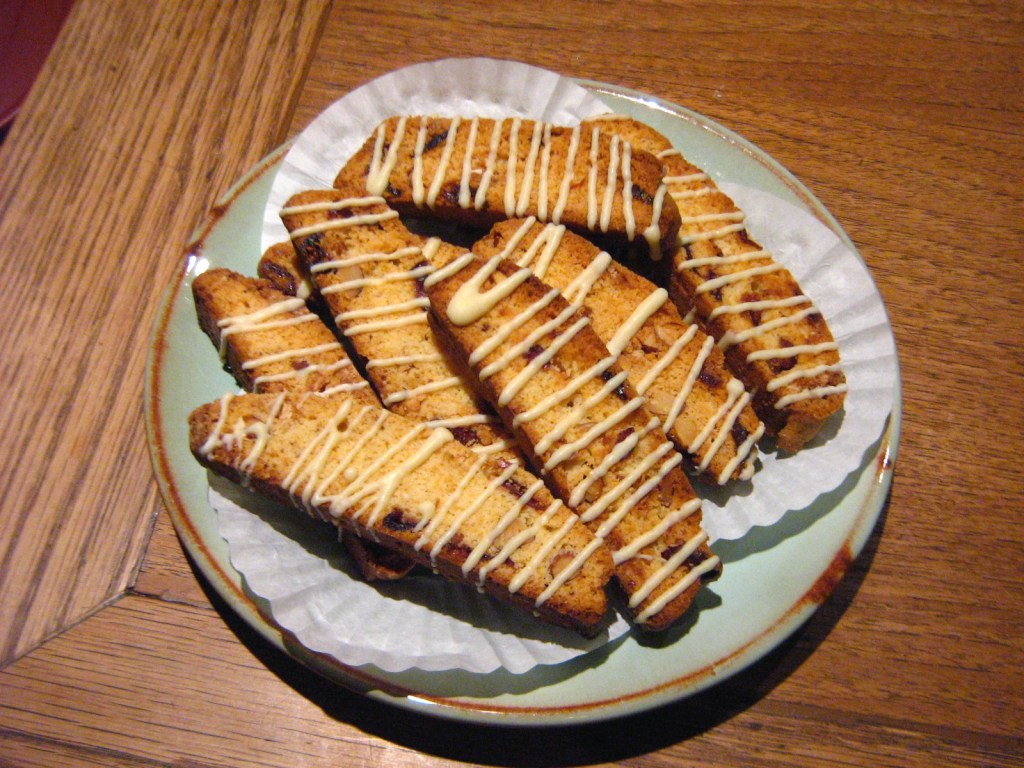
This past week has been a flurry of butter, sugar, flour, parchment paper, the whirring of the KitchenAid mixer, and the beeping of the oven timer. I’ve made five kinds of cookies, chocolate truffles, macarons, and stollen dough. I’ve been baking before work and after work, and when bedtime rolls around, my back and feet are killing me and I spend the night dreaming of cookies. But it’s all good. I love it. Baking cookies is what my Christmas is all about . This biscotti recipe is one of my favorites to bake at Christmas, because it gets awesome reviews from whoever receives them – especially Lynette, who asks, “Are you making the biscotti?” every year .
I first discovered this biscotti (from the Baker’s Best Chocolate Cookbook) in “Cafeteria” class in grade 10 or 11 (essentially pre-cook’s training). They were SO GOOD that I asked my Mum for the cookbook just so I could have the recipe. The first time I tried them at home, I burned them. I remember having dozens of slightly charred biscotti in the freezer because my Mum wouldn’t let me throw them out after putting all that white chocolate and fruit and nuts in them. Sigh. But obviously, I didn’t let that burnt experience stop me from trying again .
Biscotti is (are?) essentially a giant cookie log, baked, sliced, baked again, and in this case, drizzled with white chocolate. The original recipe calls for apricots, but cranberries seem more festive and they are nice and tart against the sweetness of the white chocolate. This year I added some Grand Marnier to the batter for extra festiveness, but orange juice is fine too .
Happy Christmas Baking!
White Chocolate Cranberry Almond Biscotti
Adapted from Baker’s Best Chocolate Cookbook (Kraft Canada, 1995)
Preheat oven to 350F.
In a mixer bowl or by hand, cream together:
1/2 cup butter
1 cup sugar
2 eggs
Beat until light and fluffy.
Stir in:
3 oz white chocolate, melted and cooled slightly
1 tbsp orange liqueur (such as Grand Marnier)
3 tbsp orange juice (or omit the liqueur and use 4 tbsp orange juice)
1 tsp vanilla extract
In a bowl, combine:
3 cups all purpose flour
2 1/2 tsp baking powder
1 tsp salt
Stir gently into the butter/sugar mixture, then add:
3/4 cup chopped toasted almonds
3/4 cup dried cranberries
3 oz chopped white chocolate
If you are using a mixer, stir in these last additions by hand.
Line two cookie sheets with parchment paper and divide the dough evenly between them. Using wet fingers, shape the dough into 2 long, flat logs, about 2 1/2 inches wide. Bake in the top and bottom thirds of the oven for 25-30 minutes, rotating the pans halfway through, until golden. Cool for 10 minutes (or until firm in the center), then slice with a sharp serrated knife into 1 cm / 1/2 inch thick slices. Arrange the slices in a single layer on the cookie sheets and bake for 16-20 minutes until lightly golden, turning the cookies over after 8-10 minutes and rotating the pans every 4-5 minutes so the cookies brown evenly. Cool completely on a wire rack, then drizzle with 4 oz melted white chocolate (if desired). Store in an airtight container.
The thing that always stumps me about quiche is the crust. The pastry crust for quiche needs to be par-baked before adding the filling, otherwise it won’t cook through and will be soggy (and nobody likes a soggy-bottomed quiche). My go-to pie crust has a tendency to shrink a lot when par-baked, and other pie crust recipes I’ve tried that are supposed to be “more suited” to par-baking come out with the texture of cardboard (just as bad as a soggy-bottomed crust).
So, I’ve been looking for a pastry crust that stays flaky and doesn’t shrink too much when par-baked, and I finally found one! Also, I discovered the secret to stopping the pastry from sliding down the sides of the pie plate while baking. Success!
Minimum shrinkage and maximum flakiness
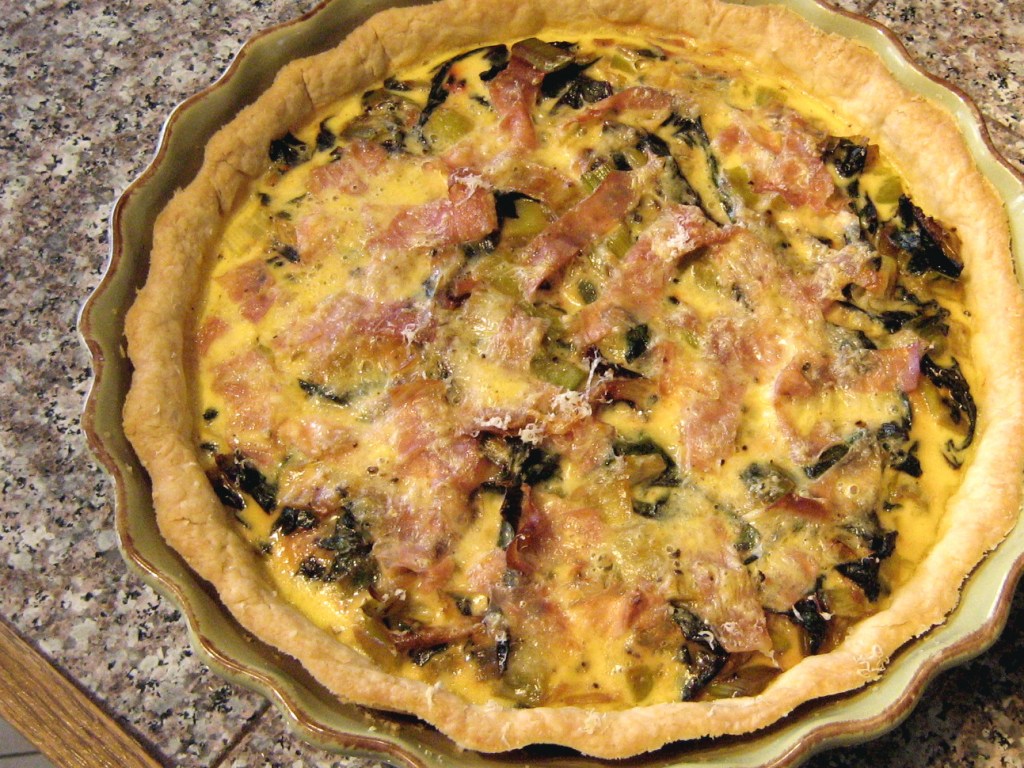
The great thing about quiche is that it is infinitely adaptable to whatever you have on hand. I happened to have some beautiful locally grown leeks and Swiss chard, and I threw in some prosciutto for flavour. Yum. I only used three eggs in the custard filling, but it could have used a bit more, so I’m increasing the amount of custard in the recipe. Enjoy!
Leek, Swiss Chard & Prosciutto Quiche
In a large frying pan over medium-high heat, melt together:
1 tbsp butter
1 tbsp olive oil
Add:
2 cups chopped leek (about 1 large leek)
1 clove garlic, chopped
Cook until softened, then turn the heat down to medium and cook until the leeks start to caramelize. Add:
4 cups chopped chard (remove the stalks if they are tough)
Cook until the chard is wilted and season well with salt and pepper. Set aside to cool.
Meanwhile, chop:
60 grams thinly sliced prosciutto ham
Set aside.
For the custard, combine:
4 eggs
3/4 cup plain yogurt or milk
1/4 tsp each salt and pepper
1/8 tsp cayenne
Pretend there are 4 eggs in here...
To assemble the quiche, sprinkle a handful of grated parmesan cheese over the bottom of the cooled par-baked pie crust (recipe below). Top with half the prosciutto, then the leek and chard mixture, and then the rest of the prosciutto. Sprinkle with another handful of parmesan, and pour the custard evenly over the filling. Bake at 350˚F for 40-45 minutes, until the middle of the quiche is just set. Serve warm or at room temperature.
Baked Single-Crust Pie Shell
From The Complete Canadian Living Cookbook. Makes one 9″ single pie crust.
In a bowl, combine:
1 1/2 cups all purpose flour
1/4 tsp salt
Add:
1/4 cup each cold butter and shortening, cubed (or 1/2 cup butter only)
Cut into the flour with a pastry blender or two knives until it resembles coarse bread crumbs.
In a liquid measuring cup, combine:
1 egg yolk
1 tsp lemon juice
enough ice water to make 1/3 cup
Drizzle the egg mixture over the flour mixture and toss briskly with a fork to combine into a shaggy dough. Press the dough into a flattened disc, wrap in plastic, and refrigerate for at least 30 minutes.
Roll out the dough on a lightly floured surface to fit a 9″ pie plate. Press the pastry into the pie plate, making sure it fits snugly against the bottom and sides (this will help minimize shrinkage). Cut off the excess pastry by rolling your rolling pin over the top edges of the pie plate. Refrigerate while the oven preheats to 400˚F.
When the oven is ready, line the pastry crust with foil and fill it with pastry weights (little ceramic marbles) or dried beans or rice, making sure to push the weights up against the sides (this will help prevent the pastry from melting down the sides). Bake for 15 minutes, then remove the weights and foil and prick the pastry all over with a fork. Bake 10 minutes more, until lightly golden. Let cool before filling.
I love grocery shopping. Browsing through the aisles, checking out new and different products, gaining inspiration by imagining what to make with all these interesting ingredients. I especially love exploring a new grocery store (yes, I said exploring!), particularly when it’s a specialty grocery store. To me, a health food store fits into that specialty category – aisles full of gluten-free this and 100% organic that, all natural cosmetic products and bulk sections to die for. I definitely have a soft spot for a good health food store.
So imagine my delight when I came across a brand new (2 weeks old!) health food store down by Capital Iron, called Ingredients Health Food Store & Apple Café. Despite the store’s newness, the staff were very knowledgeable about their products, and incredibly friendly on top of that. I spent a good thirty minutes in the store, perusing the grocery aisle (organic, gluten-free, vegan, sprouted grain, unprocessed, naturally sweetened products), cooler aisle (various soy and tofu products, nut butters and milks and more), produce section (organic/local) and bulk section (extensively gluten-free and very well priced). The bulk section was the most impressive: they had all the expected grains, dried beans, pulses, and fruit, as well as a ton of dried herbs, loose teas, coffee beans, and about four varieties of TCHO chocolate pieces (which I will definitely be back to purchase for the upcoming orgy of Christmas baking that will be taking place in my kitchen over the next few weeks). The store encourages people to bring in their own bulk containers to fill up right in the store, and they sell mason jars and other containers at cost to encourage people to use them instead of disposable bags.
I didn’t venture into the café part of the store, but a quick browse of the website shows that they make their own almond milk, specialize in organic, vegan, gluten free, and raw goodies, and serve Drumroaster Coffee (roasted in Cobble Hill).
Places like this make my inner Salt Spring hippy hippie do a happy dance, so I will be looking for any excuse to go shopping there. I would encourage anyone in town to check it out too: Ingredients Health Food Store & Apple Café, 2031 Store St., Victoria BC.
I’m a very enthusiastic fan of pretty much any Mexican-inspired food, especially if it involves smokey, spicy chipotle. Because this soup is both Mexican-ish and chipotle-enhanced, it has quickly become one of my favorites, and is frequently seen in the week-night meal rotation because it can be whipped together quickly with mostly just pantry items. It is flavoured not only with chipotle and orange, but also cumin, which may cause some people, upon entering the house while you’re making this, to announce, “It smells like B.O. in here!”. Cumin has that affect, sadly. Rest assured, however, that this soup does not taste like B.O.!
I was trying to be fancy for the blog and I was also feeding two carnivorous males, so I topped each bowl of soup with some crumbled cooked Chorizo sausage. It was nice but totally optional – I find this soup to be hearty enough with just a dollop of plain yogurt or sour cream and a sprinkling of cilantro, or even totally unadorned. Regardless of how dressed-up or dressed-down you decide to go, this is a great winter meal: warm and satisfying, with enough spice to bring your taste-buds out of hibernation – and did I mention easy?!
Black Bean Soup with Chipotle and Orange
Adapted from Hollyhock Cooks (thanks for sharing, Mum!). Makes about 6 servings. The recipe can be halved, but it tastes even better the next day so why not make the whole thing and enjoy the leftovers?
In a Dutch oven, heat 2 tbsp olive or vegetable oil over medium heat. Add:
2 cups finely chopped carrots (about 2 large carrots)
2 cups finely chopped onion (about 1 large onion)
2 cloves minced garlic
Sauté the vegetables for about 5 minutes, until starting to soften. Add:
1 tsp salt
2 tsp chipotle purée (or 1 chipotle chili in adobo sauce, finely minced)
2 tsp cumin
Stir and cook for 5 more minutes. Add:
2 x 540 ml cans black beans, rinsed (or 4 cups cooked)
4 cups water or stock (vegetable or chicken)
Stir, cover, and bring to a simmer. Simmer for 30 minutes on low heat.
After 30 minutes, use an immersion blender to partially purée the soup to a still-chunky consistency (or transfer half of the soup to a blender and purée, then return to the pot). Stir in:
1 x 796 ml can diced tomatoes, drained (or 3 cups chopped fresh tomatoes)
1/2 cup fresh orange juice (concentrate will work too!)
Reheat the soup and season with salt and pepper. To serve, top with any/all/none of the following: a dollop of sour cream or plain yogurt, crumbled cooked Chorizo sausage, cilantro. I made cornmeal biscuits to serve with it, which were made from my Home Ec Scones recipe by using 1/3 cup cornmeal + 2/3 cup flour and adding a handful of grated cheddar.