Archive | October, 2011

Daring Bakers: Povitica

27 Oct

The Daring Baker’s October 2011 challenge was Povitica, hosted by Jenni of The Gingered Whisk. Povitica is a traditional Eastern European Dessert Bread that is as lovely to look at as it is to eat!

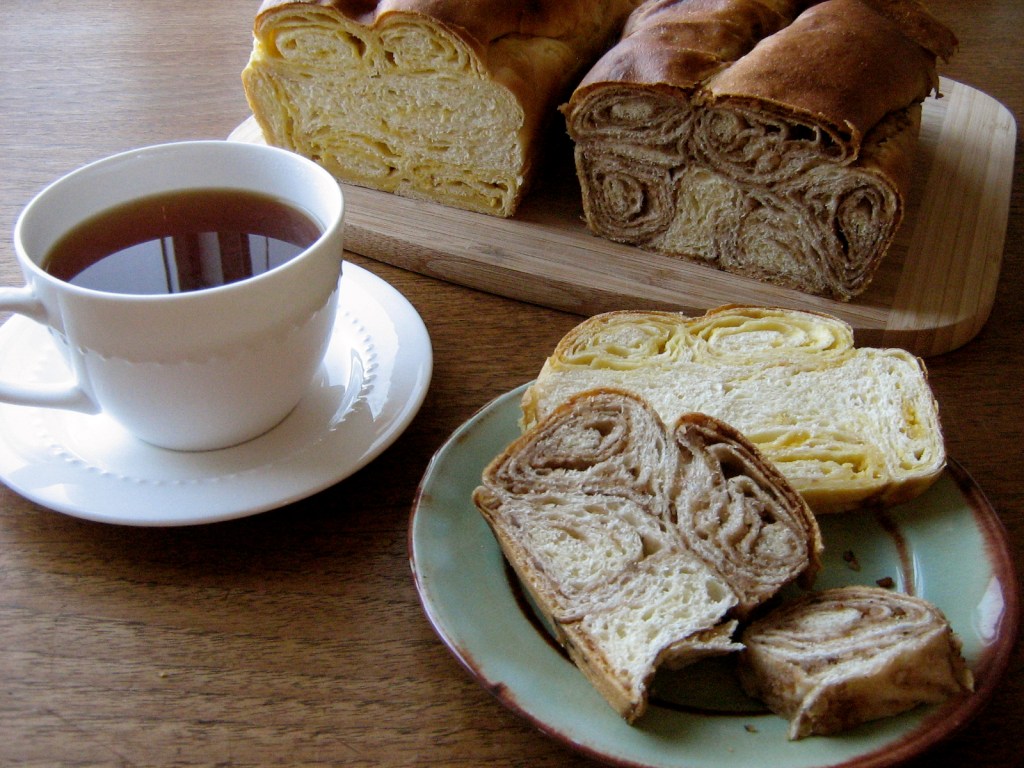
My first thought when I saw this month’s challenge was, “What the hell is povitica?”. When I found out that it was a walnut-filled bread, I have to admit that I was not super excited about it – we had just done croissants last month, and I was hankering for something drenched in chocolate. However, once I started seeing some of the beautiful loaves showing up on the Daring Baker’s members’ forum and reading all the various iterations of, “OH MY GOD THIS IS SO GOOD!!!”, I decided to pull up my socks like a big girl and get over my attitude problem. And I’m really glad I did, because this is a beautiful, delicious bread!Povitica (po-va-TEET-sa) is made from a sweetened yeast dough enriched with butter, milk, and eggs, that is rolled or stretched out very thinly, spread with a filling (traditionally walnut), rolled up, and coiled into a loaf pan to bake. When sliced, the rolling and coiling produces this amazing swirl pattern in the loaf, making it just as beautiful and impressive-looking as it is tasty. Because making povitica is quite labour intensive, what with stretching the dough out to cover your entire kitchen table, it is available for purchase from specialty bakeries for ridiculous prices – upwards of $25 a loaf! Needless to say, making it yourself costs only a fraction of that, which is just one of the great things about home baking ;) .Jenni developed this recipe herself (kudos!!) and the original yield was for four loaves, which is about three more loaves of bread than I need at one time. With the intention of bringing some to share at work, I halved the recipe to make two loaves – one with the traditional walnut filling (because all the Daring Bakers who had tried it, loved it), and one with an apricot-cream cheese filling that I sort of came up with on the fly. Both turned out well, but the walnut filling was amazing. Very lightly spiced with cinnamon and cocoa powder, I wanted to eat it by the spoonful, and it tasted great in the bread. I did end up taking some of each loaf to work, where they got rave reviews and everyone was very impressed by the spiral patterns.Thank you Jenni for sharing this recipe with us! Such a beautiful bread that I never would have made otherwise, and am looking forward to making again :) . Check out the Daring Kitchen for the original challenge recipe and a slide show of everyone’s poviticas.

Povitica

Dough and Walnut Filling recipes by Jenni of The Gingered Whisk; Apricot-Cream Cheese Filling recipe by me

Makes 2 loaves

Dough

Because you have to stretch this dough out very thinly, you want it to be pliable but not breakable. This is achieved by making a dough that is a little on the wet side and then kneading it enough for the gluten to develop. Don’t add too much flour when making the dough – it should be a bit sticky, and will become less so with kneading. This is easily done in a stand mixer.

To activate the yeast, combine the following in a small bowl and let sit for 5 minutes, until foamy and large:

1 tsp sugar

1/2 tsp all purpose flour

1/4 cup warm water

1 tbsp dry yeast

(I used instant yeast so technically this “activating” step was unnecessary but still fun to watch the yeast foam up!)

In a saucepan, heat until scalding:

1/2 cup milk

Allow to cool slightly. Meanwhile, measure out:

4 cups all purpose flour

Sift the flour after measuring and set aside.Pour the milk into a stand mixer bowl and stir in:

6 tbsp white granulated sugar

1 1/2 tsp salt

Add:

2 cups sifted flour

1/4 cup melted butter

2 beaten eggs

the activated yeast mixture

With the dough hook attachment on your mixer, stir the mixture on low to combine. It will be very wet and gloopy.Add the remaining 2 cups of flour, bit by bit, until the dough is still sticky but starts to come away from the sides of the bowl (this may require slightly more or slightly less flour – but you want the dough to be sticky, not dry). Turn the speed up a notch and knead the dough for about 10 minutes (you may need to stop to pull the dough off the hook a few times), until it cleans the sides of the bowl.

Before and after kneading

When gently stretched, it should create a “window pane” – that is, get thin enough to see light through without breaking.Divide the dough in half and place each half in a lightly oiled bowl. Cover loosely with plastic wrap and a tea towel and let rise in a warm place for one and a half hours, until doubled in size. While the dough is rising, make the filling.

Traditional Walnut Filling

Makes enough for 2 loaves

In a bowl, combine:

3 1/2 cups ground walnuts

1 cup sugar

1/2 tsp cinnamon

1/2 tsp unsweetened cocoa powder

Heat until boiling:

1/2 cup milk

1/2 cup unsalted butter

Pour the hot milk over the walnut mixture, and stir in:

1 egg, beaten

1/2 tsp vanilla extract

Stir to combine. The mixture should be quite runny, like liquid honey. Add more warm milk if needed to adjust the consistency – it will thicken a bit as it cools. Let cool to room temperature.

Apricot-Cream Cheese Filling

Makes enough for 2 loaves

In a saucepan, combine:

2 cups dried apricots

1 cup water

zest from half an orange

juice from a whole orange

4 tbsp sugar

Bring to a boil and simmer gently until the apricots are plump and soft and there is only a little liquid left in the pot. Cool slightly then transfer the apricots and liquid to a food processor. Process until smooth (some small chunks are okay). Add:

8 oz cream cheese, softened and cut in cubes

2 tbsp all purpose flour

1 egg, beaten

dash of salt

Process until mixed, adding warm water as needed to thin the mixture to a spreadable consistency. Let cool to room temperature.

To Assemble the Loaves

Cover your workspace (ie, kitchen table) with a clean sheet or cloth. Sprinkle lightly with flour (use the flour sparingly) and place one portion of double-risen dough on the floured cloth. Roll it out to about 12″ square and drizzle with 1 – 1 1/2 tbsp melted butter. Spread the butter over the top of the dough with your hands, then reach underneath the dough and gently start to stretch it with your hands, starting from the middle and working towards the edges. Try to keep it in a roughly rectangular shape with the short sides of the rectangle 18″ long – this will make fitting it into the 9″x5″ loaf pan much easier (hindsight is 20/20!). Stretch the dough as thinly and evenly as you can – it should be thin enough to read through and will be very large.Check the consistency of your filling and add warm liquid to thin it as needed – it should be easily spreadable (the walnut filling should be almost runny). Drop the filling by spoonfuls over the stretched dough and spread it out evenly with a rubber spatula to within half an inch of the dough’s edges.Lifting the sheet to help you, roll up the dough from one short (18″) side to the middle, then repeat from the other short side, so you end up with two rolls, side by side.

Ideally, the rolls should be shorter (18" long) and fatter than this!

Fold the ends of the rolls into the middle, then turn the loaf over so the ends are on the bottom and place it in a greased 9X5″ loaf pan.

Because my roll was longer than 18", I actually had to fold the roll into thirds to fit it into the pan.

Mix together:

1/4 cup cold strong coffee

1 tbsp sugar

Brush over the top of the loaf. Cover loosely with plastic wrap and let rest somewhere warm for about 15 minutes. While it’s resting, preheat the oven to 350˚F.

Remove the plastic wrap from the loaf and bake at 350˚F for 15 minutes, then turn down the heat to 300˚F and bake for another 45 minutes, until brown and it sounds slightly hollow when tapped on top. Check after 30 minutes to make sure it’s not browning too much – if it is, cover loosely with foil.

Remove from the oven and brush with:

melted butter (I forgot to do this)

Let cool completely in the pan on a rack before removing from the pan to slice. Will keep for 1 week at room temperature, or 2 weeks in the fridge.

Pulled Molasses Taffy

24 Oct

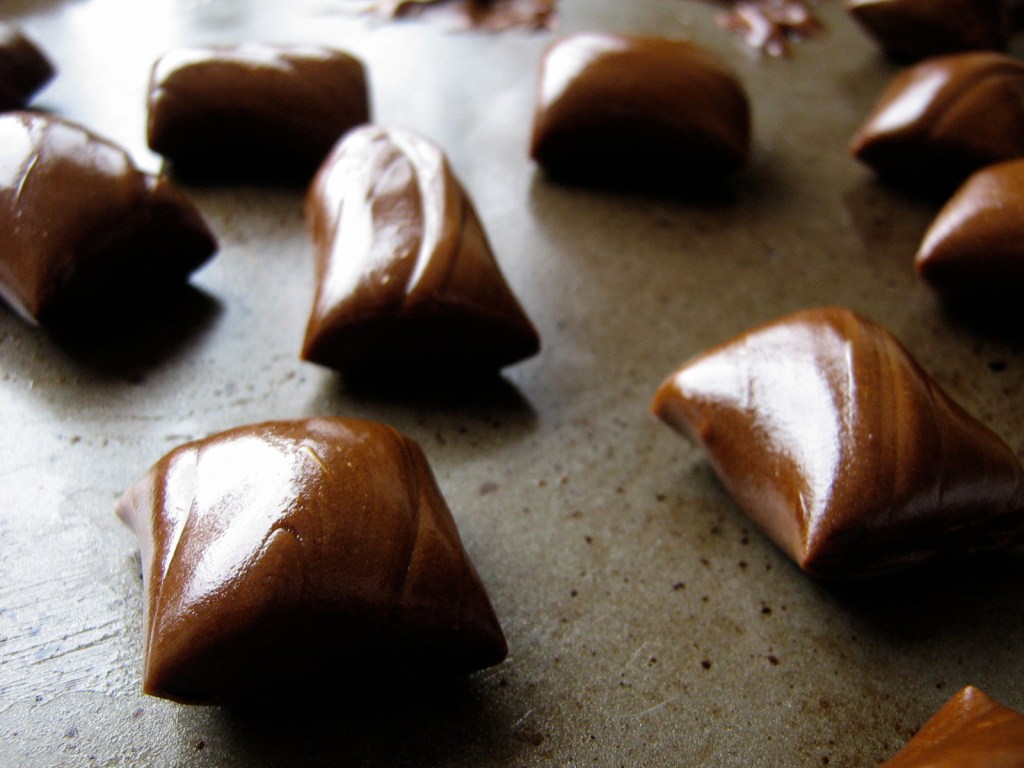
One of my favorite things about Hallowe’en, other than the adorable trick-or-treaters and watching fireworks, is the molasses taffy that comes wrapped up in the black and orange waxed paper. I love the brown sugary flavour and the chewy texture, but last year I could not find them for sale ANYWHERE, so I decided that I would try to make them myself this year. So, the other day, I did. Pulling taffy is fun in the same way that making “ghost gum” out of a marshmallow is fun, and it looks like spun gold while you’re doing it – it gets this metallic sheen that unfortunately disappears when you stop. The candies came out tasting great, but they are rather harder than I was hoping for. You’re supposed to cook the syrup to 270˚F, or the “soft crack” stage, but during the process I discovered that my candy thermometer didn’t work, so I used the “sugar syrup and water” method instead, which is less precise and resulted in a slightly overcooked syrup. But with a working thermometer, these candies would be perfect! I used blackstrap molasses, so the flavour is quite strong. If you prefer a mellower molasses flavour, use fancy molasses instead. I would also recommend using demerara brown sugar if you can find it – it is a less-refined brown sugar with more flavour than regular brown sugar, which is actually just white sugar with molasses added back into it!

Pulled Molasses Taffy

From Canadian Living

In a medium sized pot with high sides, combine:

1 1/4 cup packed brown sugar, preferably demerara

1/3 cup molasses, blackstrap or fancy, your choice

1/4 cup water

2 tbsp cider vinegar

2 tsp butter

Bring a boil, stirring, over medium heat. Attach a candy thermometer to the side of the pot and without stirring, let the mixture cook over medium heat until it gets to 270˚F. Alternately, test the temperature by drizzling a bit of the syrup off a spoon into a cup of cold water – when the syrup forms hard but pliable threads (aka “soft crack” stage), it is ready.

While the syrup boils, mix together:

1 tsp warm water

1/4 tsp baking soda

When the syrup reaches the correct temperature, remove it from the heat and immediately stir in the baking soda mixture. It will foam up a bit – stir vigorously to dissipate the chemical reaction. Pour the taffy mixture onto a greased cookie sheet and let it cool for about 5 minutes. With a greased spatula, fold the edges of the taffy in towards the middle. Continue until the taffy is cool enough to handle and when you poke it with your finger, an indentation remains.

Pick up the taffy with well-greased hands. Pull the taffy apart with a twisting motion, then fold it in half and pull it apart again, twisting with your hands. Repeat until the taffy is glossy and light in colour with a metallic shine, about 5 minutes. Divide the taffy in half and pull/twist each half into a rope about 1/2 an inch thick. Place on the greased cookie sheet. With a pair of scissors dipped in cold water, snip the taffy into 1/2″ pieces. If the taffy is soft enough, wrap each piece individually in a small piece of waxed paper (if it’s too hard it will just rip the paper when you twist the ends). Alternately, layer in an airtight container between sheets of waxed paper.

Pasta Shells with Chicken, Bocconcini, and Cherry Tomatoes

21 Oct

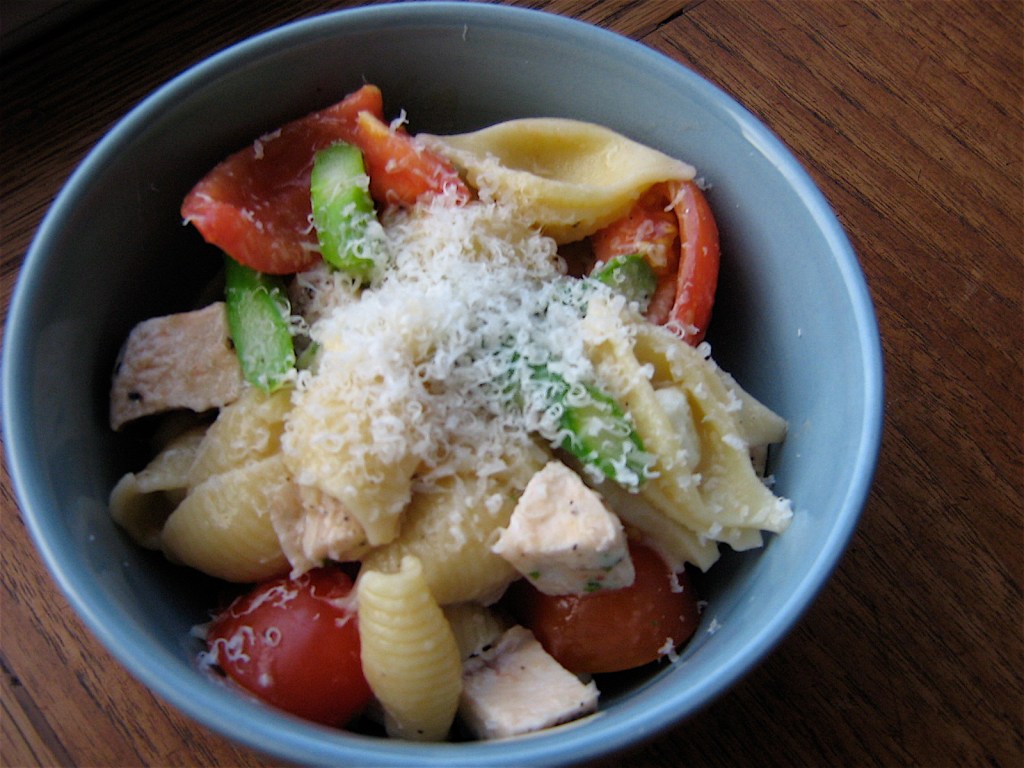
It’s been a long, busy week, and I’m kind of uninspired in the kitchen right now, so it seems that now is a good time to share this pasta dish that I made several months ago. The recipe comes from my trusted friend Martha’s Everyday Food magazine, which I was fortunate enough to have been gifted a subscription to a few years back. This is my kind of pasta: chicken, cheese, fresh vegetables, and a light sauce. It’s SUPER easy to throw together – you barely even need to use measurements, just a handful of this and a handful of that – and you can make it even easier by using left-over chicken. Aside from cooking the chicken, this is a one pot meal: you boil the pasta, drain it, and then toss everything right into the pot with the pasta along with some parmesan, butter, and a splash of the pasta cooking water. Really good, really simple, and now I want it for dinner!

One thing to note – because the tomatoes are just mixed in with the hot pasta and cooking water, they don’t actually get cooked. Nate is not a huge fan of raw tomatoes (neither am I actually, but I don’t mind them here) so next time I will give the tomatoes a quick sauté in a hot pan with some butter or olive oil before adding them to the pasta.

Pasta Shells with Chicken, Bocconcini and Cherry Tomatoes

Adapted from Martha Stewart; serves 2 (with leftovers)

Season 6 – 8 chicken breast cutlets (depending on size) with salt and pepper, and cook on both sides under a preheated broiler or on a grill until cooked through. Cut into bit-sized pieces, cover to keep warm, and set aside.

Bring a large pot of salted water to a boil for the pasta. Meanwhile, assemble the other ingredients:

a handful of cherry or grape tomatoes (about 6 or 7), cut in quarters

several spears of asparagus, cut into one inch pieces

2 oz of bocconcini - about 2 large balls cut into 1/4″ dice, or a handful of tiny pearl or cherry bocconcini

a few handfuls of freshly grated parmesan

a small palmful of chopped parsley

1 soup bowl full of medium/large pasta shells – pasta tends to double in volume when cooked, so start with half the amount (raw) that you want to end up with (cooked) (or about 4 oz raw pasta, if you won’t want to eyeball it)

When the water boils, chuck in the pasta. When it is *just* al dente, toss in the asparagus and cook for about 30 seconds. Drain the pasta/asparagus in a colander, reserving about 1 cup of the pasta water. Working quickly so you don’t lose any residual heat, toss everything but the bocconcini in the pot along with:

about a tablespoon of butter

salt and pepper

Stir to combine, adding the reserved pasta water a little at a time until you have a light sauce coating the pasta (you probably won’t need all the water). Stir in the bocconcini. Serve with more grated parmesan on top.

Pear-Filled Vanilla Birthday Cake with Chocolate Buttercream Frosting

16 Oct

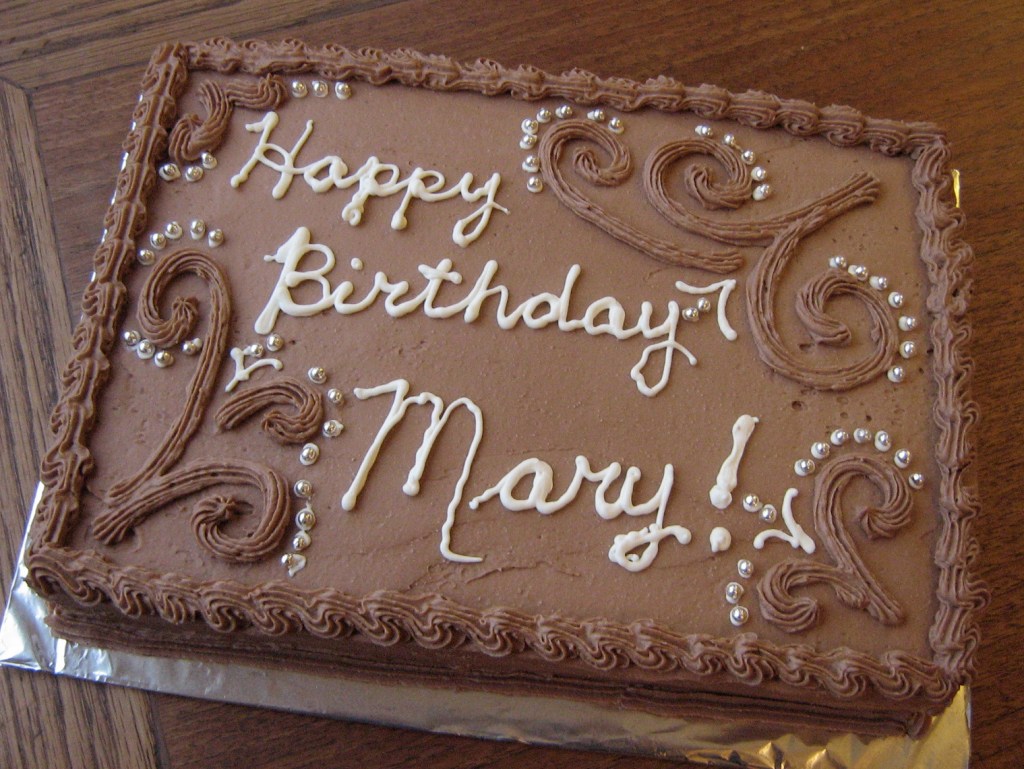
One of my co-workers recently had a birthday and a cake was requested, so I obliged with a vanilla cake filled with pears and frosted with chocolate buttercream. It went over really well at work (someone actually said, “This is the best cake I’ve ever had!” :) ) so I have a feeling I’ll be making more. This will continue the trend of me having made more cakes in the past six months than I have in the past six years, but that is totally fine with me ;) .

The slightly battered piece I brought home for Nate

This vanilla cake (aka yellow cake, because it contains egg yolks) is super easy to make and comes out fluffy, moist, and delicious. It’s my favorite plain cake recipe because it doesn’t require any fancy ingredients and it could easily be jazzed-up-up with lemon or orange zest or something. I baked it at a slightly lower temperature than the recipe stated and wrapped the pan in strips of damp towel to insulate it against getting a big domed top, and the cake came out perfectly baked and perfectly level. I wanted to fill it with something fruity, and over Thanksgiving my mum gave me a big bag of gorgeous pears from her pear trees, so I sautéed some in butter and brown sugar and spread it between the cake layers. I also wanted to try proper Swiss meringue buttercream frosting after the cream cheese frosting fiasco, and it came out awesome! Fluffy, buttery, and not too sweet. I can’t wait for an excuse to make it again in another flavour. Plus it was really fun to decorate with :) .

Pear-Filled Vanilla Cake with Chocolate Buttercream Frosting

Because of all the butter in the frosting, this cake should be stored in the fridge, but let it come to room temperature before serving – the texture of the filling will be much better, and cake tastes best when it’s not cold anyway!

Yellow Vanilla Cake

Modified slightly from A Passion for Baking by Mary Goldman.

Can be baked as a sheet cake in a 9″x13″ pan, as a circular layer cake in two 9″ round pans, or as 24 cupcakes. The original recipe says to bake at 350˚F, but I had success with 325˚F.

Preheat oven to 325˚F. Spray/grease your pan(s) and line the bottoms with parchment paper.

In a mixer bowl, cream together:

1 cup unsalted butter, softened

1 1/2 cups granulated sugar

Mix until light and fluffy, then add:

3 eggs (one at a time, mixing after each)

1 tsp vanilla

Mix until well blended.In a bowl, combine:

3 cups all purpose flour

4 tsp baking powder

1/4 tsp salt

Add the flour mixture to the butter mixture and mix on low speed while slowly pouring in:

1 1/2 cups warm milk

Blend until the batter is smooth. Pour into prepared cake pan(s) and spread the batter evenly. Wrap the pans in a strip of wet towel to insulate the edges of the cake from cooking faster than the middle and creating a domed top. Bake at 325˚F for 35-45 minutes, until lightly golden brown on top, slightly springy when touched, and a toothpick inserted in the middle comes out with no crumbs (check after 35 minutes). Cool for 10 minutes in the pan, then invert onto a wire rack, peel off the parchment paper, and cool completely. Split, fill, and frost as desired (it’s easier if the cake has been chilled before splitting it).

Pear Filling

In a large skillet over medium heat, melt:

3 tbsp butter

Add:

3 cups finely diced pears

Sauté until softened. Add:

3 tbsp brown sugar

a dash each of nutmeg and salt

Cook until the pears are very soft and the juice is syrupy. Stir in:

a squeeze of lemon juice

Remove from the heat and let cool before filling the cake. The butter in the filling will solidify if kept in the fridge, so serve the filled cake at room temperature (it’s fine to store it in the fridge though).

Chocolate Swiss Meringue Buttercream Frosting

From Sweetapolita. For a detailed tutorial on making Swiss meringue buttercream, click here.

Makes about 5 cups of frosting, enough to frost the outside of a 9″x13″ cake, to frost and fill a 9″ round 2-layer cake, or to frost 24 cupcakes. Best made in a stand mixer because it requires a lot of beating!

Cut 1 pound (2 cups) of butter into cubes and leave at room temperature to soften slightly. Pour a splash of vinegar or lemon juice in a mixer bowl and wipe out with a paper towel to remove any traces of oil. Also wipe down the whisk attachment with vinegar/lemon juice. This ensures that there is no oily residue that will prevent the egg whites from whipping up.

In the perfectly clean mixer bowl (not attached to the mixer), combine:

5 egg whites

1 cup + 2 tbsp granulated sugar

Make a bain marie/double boiler by placing the mixer bowl over a small pan of simmering water (make sure the bottom of the bowl is no touching the water). With the whisk attachment, stir the egg white-sugar mixture until it comes to 140˚F, or use your (clean) fingers to feel that the sugar is totally dissolved in the egg whites and the mixture is hot. Note that you are stirring to keep the mixture from turning into scrambled egg whites, not to incorporate air. Attach the mixer bowl and whisk to the mixer and beat the egg whites at medium high speed until stiff peaks form. Continue stirring on low speed until the egg whites are COMPLETELY cool – the side of the bowl should be cool to the touch.When the egg whites are cool, it’s time to add the butter. Switch the whisk for the paddle attachment, and mixing on low speed, add in the cubes of butter, one at a time, allowing the butter to incorporate before adding the next cube. The egg white meringue will fall and go through various stages of looking weird and curdled as you add the butter – this is all okay. When all the butter is added, the mixture will probably look quite clumpy, curdled, and thick. Keep stirring on low and after a few minutes it will emulsify and smooth out into a thick, creamy, fluffy frosting.Add:

2 tsp vanilla

dash salt

3/4 cup chocolate chips, melted and cooled

Stir well to incorporate the chocolate.Keep the frosting at a cool room temperature to frost the cake.

To Assemble the Cake:

Split the cooled cake in half horizontally and place the bottom layer on a cake board, protected by 4 strips of waxed paper. Pipe a wall of frosting around the edge of the layer, and spread the cake with the pear filling. Place the second layer on top, and coat the cake with a thin “crumb coat” of frosting. Refrigerate for about 15 minutes, until the frosting is set, then frost with a thicker layer. Decorate as desired – this frosting is great for piping.

Maple Coconut Pumpkin Pie with Spelt Shortbread Crust

10 Oct

Happy Canadian Thanksgiving! I still can’t believe it’s October and, according to all the store displays and lifestyle/cooking magazines, the beginning of the holiday season. Where the heck did summer go so quickly?

I’m enjoying fall though – I love the cooler weather, the coloured leaves, and the abundance of delicious, harvest food – and maybe I’m okay with the holiday season starting. Heck, I’ve bought my first holiday cooking magazine and I’m already thinking about Christmas baking. Yeah, I’m totally okay with it ;) . For me it’s mostly about the food anyway, and a Thanksgiving meal is a great way to kick it all off.

I’ve been in charge of holiday desserts in my family ever since I can remember, so this is the pumpkin pie I took to my parents’ house for Thanksgiving dinner. By the way, my mum is a turkey super-star – it is always juicy and awesome. And it has bacon on it. That’s all you really need to know.

The real turkey bacon

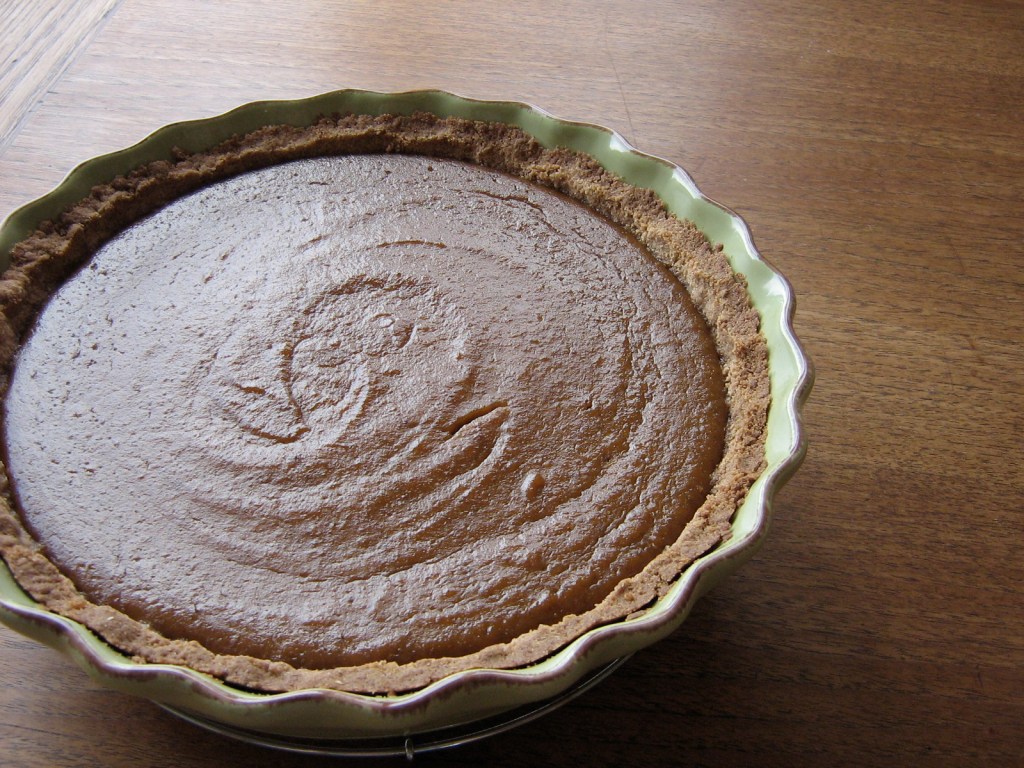
Anyway, back to pie. This recipe comes from my trusted friend Martha, and this is the second year I’ve made it. What sets it apart from other pumpkin pie recipes is the crust, which comes out tasting more like a shortbread cookie than regular pie pastry. Rather than rolling out the pastry, you just press the crust right into the pie plate and then blind bake it. This is definitely the easiest and best recipe/method I have come across for blind-baked pastry, because it doesn’t shrink or bubble up like other pastry often does.

The pumpkin filling, while quite tasty and nicely spiced, was not particularly special or unique as far as I could tell the last time I made it, so I cut out the regular white sugar and used maple syrup and brown sugar instead. I also added a splash of maple syrup to the whipped cream – because what’s pumpkin pie without whipped cream?

Because my mum can’t eat wheat or dairy, I used whole spelt flour in the crust and coconut milk instead of cream in the pumpkin custard filling (she missed out on the maple whipped cream though – next year I might try this coconut whipped cream recipe). The spelt flour gives the crust a slightly toasted flavour, and the coconut milk (which might sound weird) actually pairs really well with the pumpkin, maple, and spices. You can substitute heavy cream if you want, but I would recommend trying it with coconut milk even if you don’t have a dairy allergy!

Maple Coconut Pumpkin Pie with Spelt Shortbread Crust

Modified from Martha Stewart; makes one 9-inch pie

Spelt Shortbread Crust

A note on baking with spelt: spelt flour is a cousin of wheat flour, but is lower in gluten so it behaves a little differently in baking – basically, it absorbs less liquid and often turns out a bit crumblier. I usually think of it as similar to cake and pastry flour, but I’m not sure how accurate that actually is. In most cases, to substitute spelt for wheat flour, just increase the amount of flour by 25% (or, you can decrease the amount of liquid by 25%, but this sometimes also decreases the volume of whatever you’re making, so I usually go with the other method). However in this recipe, because there is no liquid added to the crust, a straight one-to-one substitution works.

Preheat oven to 375˚F.

In a bowl, cream together:

4 tbsp unsalted butter or margarine, softened (I used dairy-free margarine to accommodate a dairy allergy)

3 tbsp white granulated sugar

Stir in:

1 large egg yolk

Add:

1 cup whole spelt flour (or all purpose wheat flour, or 1/2 cup each all purpose and whole wheat flours)

1 tsp coarse salt

Stir until the mixture is uniformly crumbly – it should clump together easily when squeezed between your fingers. Press it evenly into the bottom and just over an inch up the sides of a 9-inch pie plate. Freeze until firm (20 minutes – I forgot to do this and it turned out fine), then bake in a 375˚F oven for 15-20 minutes, rotating half-way through, until golden brown. Let cool while you prepare the pumpkin filling.

Maple Coconut Pumpkin Filling

Preheat oven to 325˚F.

In a medium bowl, whisk together until smooth:

1 14-0z/398 ml can pure pumpkin (not pumpkin pie filling)

3/4 cup coconut milk with a high fat content (ie, not light – the one I used had 14 grams of fat per 1/3 cup – and make sure you shake the can well)

1/3 cup pure maple syrup (the darker the better – darker = more flavour)

2 eggs, beaten slightly

2 tbsp dark brown sugar (demerrara if you can find it)

1 tsp pure vanilla extract

1 tsp coarse salt

1 tsp ground cinnamon

1/2 tsp ground ginger

1/4 tsp ground allspice

1/8 tsp ground nutmeg

1/8 tsp ground cloves

Pour the filling into the prepared pie crust. Bake the pie at 325˚F  for 65-70 minutes, until the filling is slightly puffy and just set (it should still jiggle a bit). Cool completely on a wire rack, then refrigerate, uncovered, for at least 6 hours. Serve with maple whipped cream (1 cup whipping cream + 1 tbsp maple syrup).

Carrot Coconut Cupcakes

4 Oct

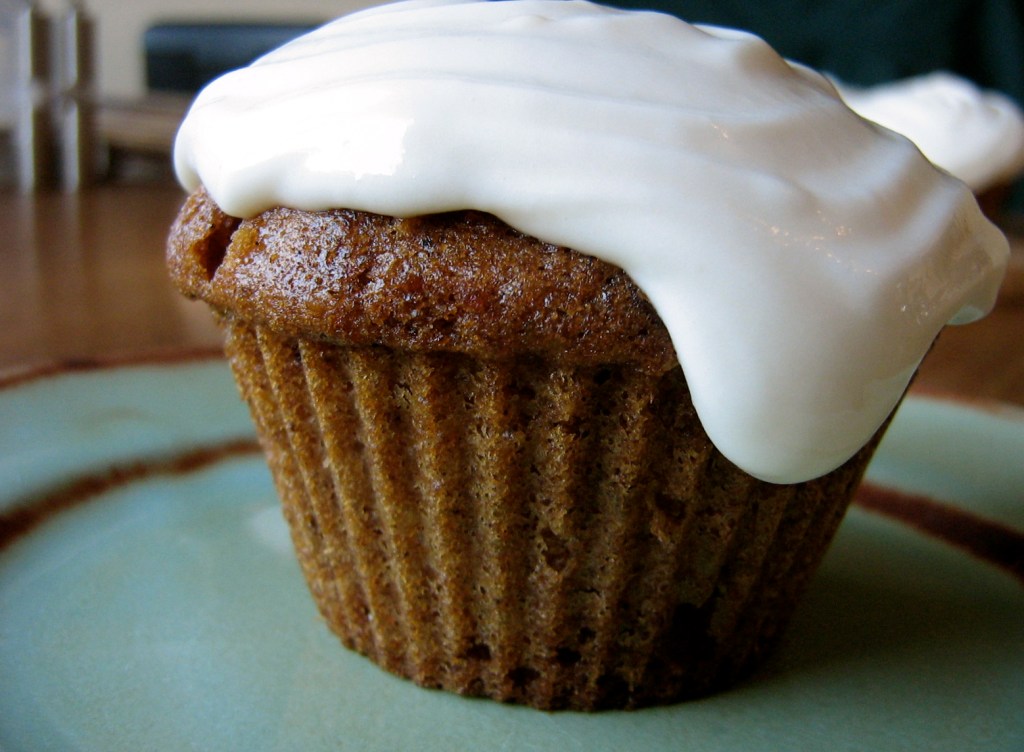
We were supposed to visit Nate’s parents for his mum’s birthday a few weeks ago, and Nate asked me to make a birthday cake, which I happily agreed to. Sadly the visit got canceled, but I already had my heart set on carrot cake, so I made it anyway as cupcakes rather than a layer cake. This is the carrot cake recipe from the rebar cookbook, and it is the best carrot cake I have ever had. I like my carrot cake with lots of stuff in it, and this one delivers: carrots, coconut, pineapple, pecans, and dates, along with a good hit of spices. Moist, crumbly and delicious – this is definitely a cake that requires a fork and a napkin. The icing that goes along with it in the cookbook is an incredibly sweet cream cheese white chocolate icing, but I decided to try this cream cheese frosting from smitten kitchen because it contains maple syrup, and in my mind, you can’t go wrong with maple syrup! Unfortunately, things did not work out so well. I’m pretty sure I used all the right amounts of everything, but the frosting remained runny and soupy (albeit delicious – sound familiar?!) no matter how much extra icing sugar I added or how long I chilled it. It tasted great – not too sweet, with a good tang of cream cheese, although not as much maple flavour as I was hoping for – but it just slid right off the cupcakes. I had to add double the amount of icing sugar to make it stay on at all, and even then there’s no way I could have piped it into spikes like I was supposed to! I must have bad cream cheese frosting mojo, because after this round the score is cream cheese frosting: 2, Korena: 0. (And I swear this was a completely different recipe and method than that damn wedding cake frosting!). Nonetheless, the cupcakes were (messily) enjoyed, and this is definitely a carrot cake to try. I am including the original cream cheese white chocolate icing because I know that it actually turns out. If you are brave, try the maple cream cheese frosting – maybe yours will work out better than mine did!

Happy Belated Birthday, Kathryn! I owe you a cake :)

rebar Carrot Coconut Cake

From the rebar modern food cookbook

Preheat oven to 350˚F. Butter and flour two 8″ round cake pans, or line 12 muffin tins with cupcake liners.

In a bowl, combine:

1 1/2 cups grated carrots

3/4 cup drained crushed pineapple

3/4 cup unsweetened shredded or flaked coconut

3/4 cup chopped pecans or walnuts

1/2 cup chopped dates

In another bowl, combine:

1 1/2 cups all purpose flour

2 tsp baking powder

1 tsp baking soda

1/4 tsp salt

1 1/2 tsp cinnamon

1 1/2 tsp ground ginger

1/2 tsp nutmeg

1/2 tsp allspice or cloves

In the bowl of a mixer fitted with the whisk attachment, beat until light and fluffy:

3/4 cup brown sugar

1/3 cup white sugar

3 eggs

2 tsp vanilla

With the mixer on low, slowly pour in a thin stream down the side of the bowl:

3/4 cup vegetable oil

Mix to blend.

Gently fold the flour mixture into the egg mixture, then fold in the carrot mixture. Scoop the batter into your prepared pans and bake at 350˚F for 25-30 minutes (cupcakes will still take at least 25 minutes), until a toothpick inserted in the centre of the cakes comes out clean. Cool in the pan for about 10 minutes, then remove and cool completely on a wire rack. Frost when totally cool, and garnish with toasted coconut or nuts (pecans/walnuts), if desired.

Cream Cheese White Chocolate Icing

In the bowl of a mixer fitted with the paddle attachment, beat until smooth and fluffy:

8 oz brick cream cheese, soft

1/4 cup unsalted butter, soft

1 tsp vanilla

Add:

3 oz white chocolate, melted and cooled but still liquid

Scrape down the sides, then slowly add:

3 cups icing sugar

Beat on high for about 3 minutes, until the icing sugar is well mixed and the icing is fluffy. Makes enough to frost 12 cupcakes, or fill and frost a two layer, 8″ cake.

Follow

Get every new post delivered to your Inbox.

Join 582 other followers