Archive | August, 2011

The Wedding Cake

30 Aug

To recap the journey thus far…

Wedding Cake Dilemma

Wedding Cake Trial

Cake for 60

Cream Cheese Swiss Meringue Buttercream: an Exercise in Perseverance

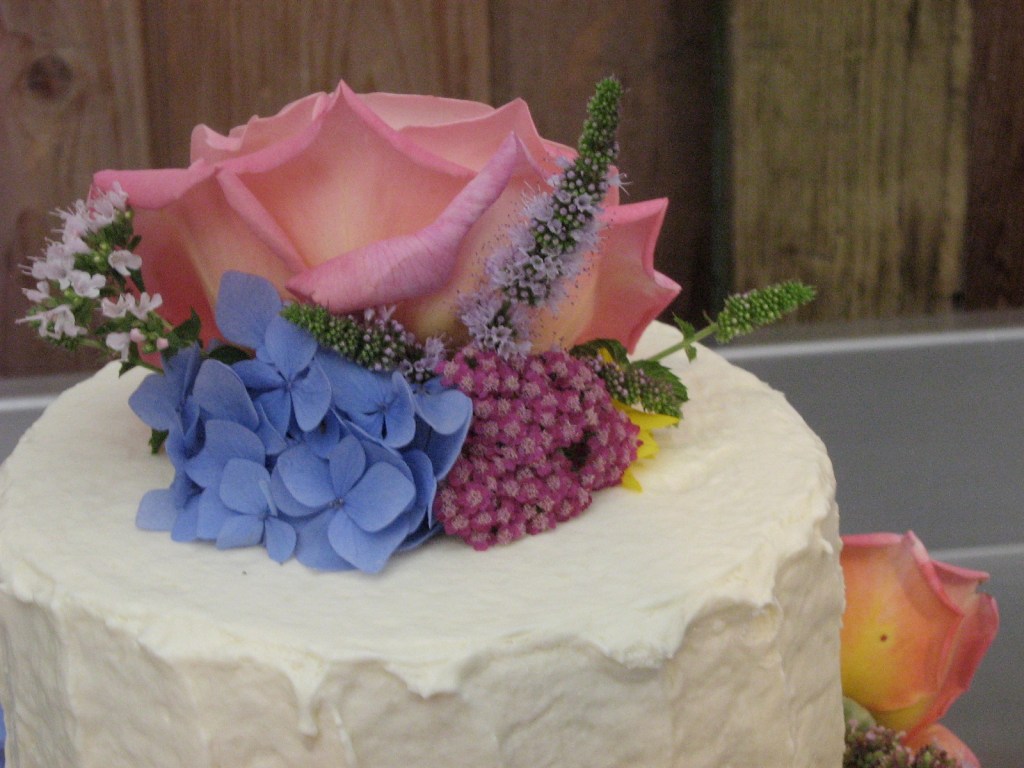
A few days before the wedding, I took the frozen cakes, icing, and all other bits over to Vancouver, then layered/filled/frosted the individual cake tiers at my grandparents’ house the day before the wedding. The morning of the wedding I recruited Lynette to babysit the cakes in the back seat of the car as I drove carefully across town (thank goodness it was cool in the morning and there was very little traffic!), where I assembled and decorated the cake at the wedding venue (The Beach House Restaurant in West Vancouver, overlooking the water – beautiful!). The whole time I was praying that the cursed frosting wouldn’t melt off the sides of the cake, but despite all the trouble it gave me, it held up just fine (even after sitting out unrefrigerated for several hours during the wedding reception) and tasted fantastic. However, it was so impossible to work with that I will not be using that particular frosting recipe again. :(

In the end, the cake as a whole turned out beautifully and it was delicious – and it didn’t melt or fall over or anything! I was hoping to get some pictures from the wedding photographer of the bride and groom cutting the cake (during which I had my fingers AND toes crossed and a horrible grimace on my face because I was terrified the whole thing would collapse!) but apparently the photos might be a while, so a) stay tuned! and b) I don’t have any pictures of what the inside looked like – but just know that this was a lemon cake with raspberry jam filling (a very easy, very delicious freezer jam – I used half a batch to fill the cake) and the-most-frustrating-but-nonetheless-delicious cream cheese Swiss meringue buttercream frosting, and everyone agreed that it tasted wonderful. :)

I got most of my wedding cake assembly tips from my trusted friend Martha, and some frosting tips from Zöe Francois’ blog post and video on frosting a cake. I would highly recommend a revolving cake decorating stand for easy frosting, as well as a large offset spatula – these were the two most useful tools I used. Continue reading 

Daring Bakers: Chocolate and Candy!

27 Aug

The August 2011 Daring Bakers’ Challenge was hosted by Lisa of Parsley, Sage, Desserts and Line Drives and Mandy of What the Fruitcake?!.  These two sugar mavens challenged us to make sinfully delicious candies!  This was a special challenge for the Daring Bakers because the good folks at http://www.chocoley.com offered an amazing prize for the winner of the most creative and delicious candy!

Did I mention that right now, Nate and I have sworn off refined sugar six days a week? Oh man, this challenge came at the wrong time! But it was also so, so right…

The premise of this month’s challenge was to have all us Daring Bakers learn to temper chocolate, and then use it in our candy creations. To temper chocolate, you heat it, cool it, and heat it again to specific temperatures in order to create small, uniform crystals of cocoa butter in the chocolate so that it stays nice and shiny when it hardens and has a good snap when it breaks. It also gives a thin, even coating to things like dipped candies. Untempered chocolate will have a mottled, dusty look when it hardens, and will crumble rather than snap cleanly when broken. For chocolate making, couverture chocolate is the gold standard – this is chocolate with a high percentage of cocoa butter that, when tempered properly, results in a shinier, snappier, mellower finished chocolate. Lisa and Mandy provided chocolate tempering instructions plus a ton of chocolate and non-chocolate candy recipes, and to be eligible for the Chocoley contest, we had to make two kinds of candy: one chocolate, and one of our choice (chocolate or otherwise).

I started out with a non-chocolate candy: sponge toffee.My friend’s mum used to make this when we were kids and it was awesome. Lisa and Mandy provided a recipe, but many people commented that it tasted strongly of baking soda (which you add to the caramelized sugar to get it to foam up), and the bubbles in the toffee were quite large. I wanted smaller bubbles, so I used a recipe that includes gelatine, which somehow makes the texture a little more “refined”. At the advice of other Daring Bakers, I reduced the amount of baking soda from 1 tbsp to 1 tsp, and ended up with a smoothly textured, rock hard sponge toffee full of tiny bubbles – but no baking soda taste ;) I think I could have safely used 2 tsp, or even the full tablespoon, of baking soda to get a less dense but equally tasty final product. Once I broke it into smaller pieces it was much more manageable, and it tasted great – when it wasn’t getting stuck in your teeth and threatening to dislodge them from your jaw ;)

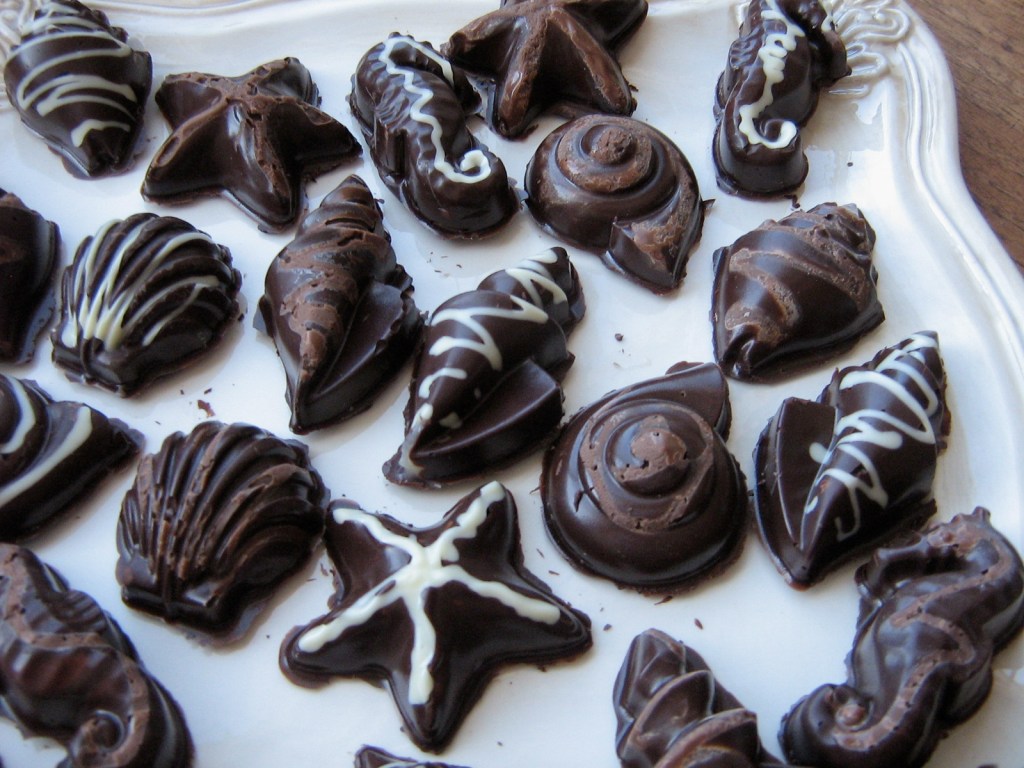
After the toffee, I moved onto the chocolate. I make rolled and dipped chocolate truffles every year for Christmas, but I had never actually bothered to temper the chocolate before, and I had never made a filled chocolate bonbon in a mold, which was one of the suggested candy-making methods. I have this cute metal pan that I thought was for making tiny shell-shaped cakes, but then I saw it on the Chocoley site as a professional-quality chocolate mold, so I guess it was meant to be for this challenge.First I had to temper the chocolate to coat the mold with. I tried the “seeding” method, where you chop up the chocolate, melt about two-thirds of it over a bain marie (simmering pot of water) to bring the temperature up, stir in the remaining un-melted third to bring the temperature down, and then heat it again to the proscribed temperature

Un-melted chocolate, meant to lower the temperature of the melted chocolate...

In theory, this is all easy and straight-forward, but in practice, not so much. You have to be fairly precise about the temperatures that you heat, cool, and heat the chocolate to, and if you mess it up, you have to start again (which is also a blessing, I guess, rather than having it ruin the chocolate!). I used a glass bowl to melt the chocolate over the bain marie, and the glass acted as insulation and kept the temperature of the chocolate rising even after I’d removed it from the heat and was supposed to be cooling it down. In the end, I found it easiest to melt all of the chocolate at once over the bain marie to bring it up to temperature, submerge the bowl in cool water to bring the temperature down, and then heat it again over the bain marie to bring it to the final temperature. I think it took me about three tries to get it right!

Making a filled chocolate in a mold also sounded pretty straight-forward, but just like tempering the chocolate, it wasn’t (for me, anyway). To make the outer chocolate coating, you fill the cavities of the mold with tempered chocolate, dump it out (leaving a coating of chocolate behind), scrape off the excess chocolate, then let it harden in the mold before filling it up and capping it off with more chocolate. I drizzled white and milk chocolate in the cavities of the mold before adding the dark chocolate coating, and I stuck the metal pan in the fridge to set the drizzled chocolate.Big mistake. When I filled the cavities with tempered dark chocolate to make the outer shell, it thickened up on contact with the cold metal and wouldn’t come put when I tried to dump out the excess. I had to sort of scrape it out and hope that I had left enough of a coating. I had better luck spreading the chocolate into the cavities using a teaspoon.

For the filling, I made two kinds of ganache. In Paris about 10 years ago I had a chocolate lava cake with thyme-infused vanilla ice cream that was absolutely to die for, and I’ve had my eye on a caramel ganache truffle recipe for a while, so I decided to combine them into a thyme-infused dark chocolate caramel ganache filling.I’ve been on a strawberry rhubarb kick this spring/summer, and I discovered that ginger pairs really well with those flavours, so I also came up with a strawberry-rhubarb-candied ginger white chocolate ganache filling.The thyme-caramel ganache was my favorite – very subtle but totally delicious.
Continue reading 

Wedding Cake Teaser

25 Aug

Alright, I know I keep saying this, but the wedding cake post is coming, I PROMISE! There’s just been so much going on, and I was hoping to get some good photos from the wedding photographer, but alas, they are not ready yet. In the meantime, here’s a few “in progress” pictures to keep everyone happy.The real post will be up next week :)

Banff Cobbler

23 Aug

Yesterday was my first day back at work after four months off, and in answering the inevitable “what did you do this summer?” question several times, I realized that I had a jam-packed summer: a ten-year high school reunion, a trip to California, a concert in Vancouver, a stagette and two weddings (the wedding cake post is coming, I promise!!), and a road trip to Banff, Alberta, with Lynette – not to mention a ton of cooking and baking in between it all. No wonder it’s been a while since my last post!

The Banff road trip was an almost-2000 kilometer round trip across British Columbia and into the Rocky Mountains to visit our friend Tangle and her boyfriend Tyler.

Banff is really beautiful, even without the fancy iPhone camera filter

It was a beautiful drive (but looooong), and the visit was full Disney musical singalongs, mountain climbing, picturesque views, and great food courtesy of Tyler.

Dinner one evening

Breakfast the next morning (notice the icing sugar heart!)

On our last day there, we picked up some raspberries and blackberries at the Farmer’s Market, and the fruit guy threw in a slightly bruised peach for free. Another friend gave us some more raspberries from his garden (of both the red and pale yellow “Champagne” variety), and we decided that we needed to make some kind of berry dessert. Quite frankly, I was dying to get into the kitchen myself, and my uncle had sent me a link for a berry cobbler that I wanted to try, so I eagerly volunteered to make a raspberry-blackberry-peach cobbler as the dessert course to our meal of elk and bison steak.

A cobbler is sort of like a crumble, only the topping contains an egg and baking powder along with the flour, butter, and sugar, so you end up with a layer of cookie-crossed-with-biscuit on top of the fruit. The filling is just fruit and sugar but it thickens up during baking so that you end up with juicy (but not runny) fruit topped with a buttery, sugary, crisp pastry. The only thing that would have made it better was a scoop of vanilla ice cream or a drizzle of heavy cream. My advice is to make and eat this RIGHT NOW – it’s perfect for all the fruit and berries in season! Continue reading 

Chicken Fajita Lettuce Wraps

12 Aug

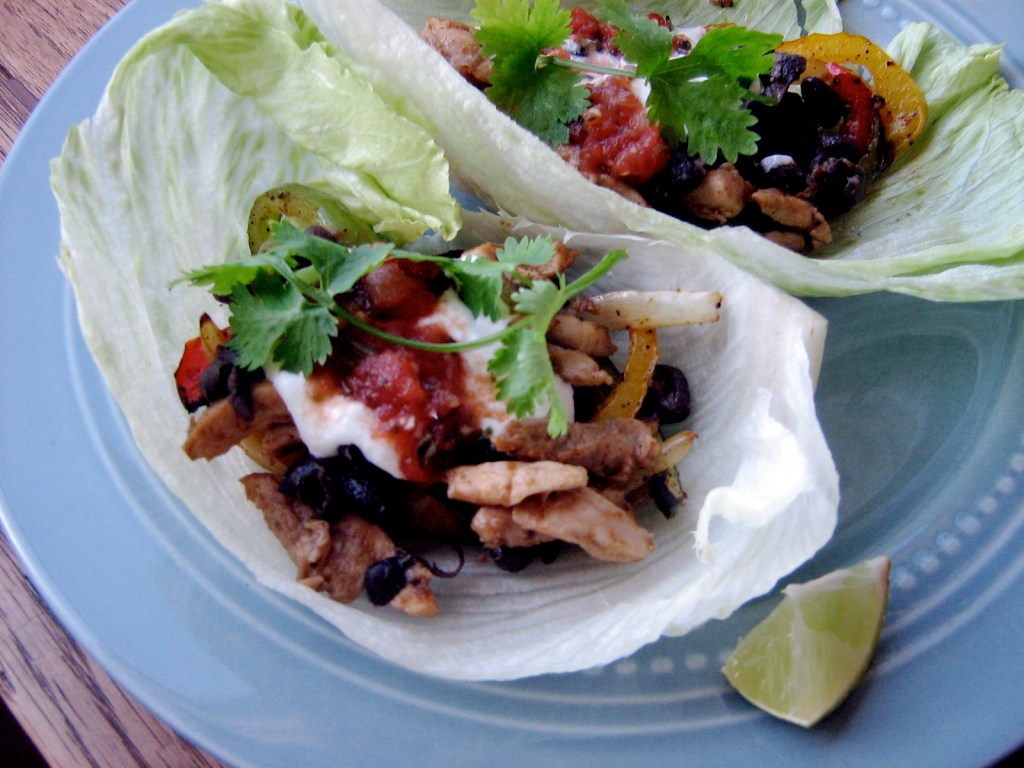
Nate and I have recently sworn off sugar and starchy refined carbs six days a week, with a cheat day on Saturday (you certainly would not guess this based on the amount of sugary, cakey recipes that I’ve been posting lately, but that’s precisely why we’re doing this!). It hasn’t been as difficult as I thought it would be; it just means reinventing some recipes, mostly by adding more vegetables. Fajitas are an easy one – you replace the tortilla with a leaf of lettuce, and it’s just as good, plus you get another serving of vegetables in the meal. This recipe would also be good with beef or pork, cut into thin strips, and obviously, whatever toppings you want. You could even put the filling into a wheat or corn tortilla – but lettuce is a little more adventurous (and messier!!) ;) I really like this method of broiling the peppers and onions – it gives the filling a nice charbroiled taste.

And for anyone who is wondering, I’m waiting to see if I can get some good photos from the wedding before I post about the wedding cake. It’s coming, I promise! Continue reading 

Eating Out in San Francisco, Part II: Dinner at Millennium

9 Aug

Read Part 1: Lunch at the Zuni Café

After stuffing ourselves full of delicious Zuni Café roast chicken at lunch, we spent the rest of our San Francisco afternoon shopping in Union Square and Chinatown (I bought a dress, some shoes, a ring, a scarf, and a comforter – because that’s a really easy thing to bring home in a suitcase, right?!), and then finally ended up at Millennium for dinner. Millennium is a vegetarian restaurant that specializes in healthy, sustainable, environmentally-friendly foods, served in a very up-scale manner. In fact, their entire menu is actually vegan – completely free of animal products – but they stick with the vegetarian label because it is more approachable. Nonetheless, the phrase “vegetarian restaurant” can conjure up images of aging hippies eating bean sprouts, brown rice, and tofu by the forkful, not ladies sporting Fendi Spy handbags, enjoying sophisticated food in an elegant, white-linen’d dining room. But that’s exactly what Millennium delivered. Plus they had these really cool light fixture things:

Apparently the "fishnet" is made of recycled paper bags, and the curtains behind are made from recycled plastic bags. Talk about sustainable!

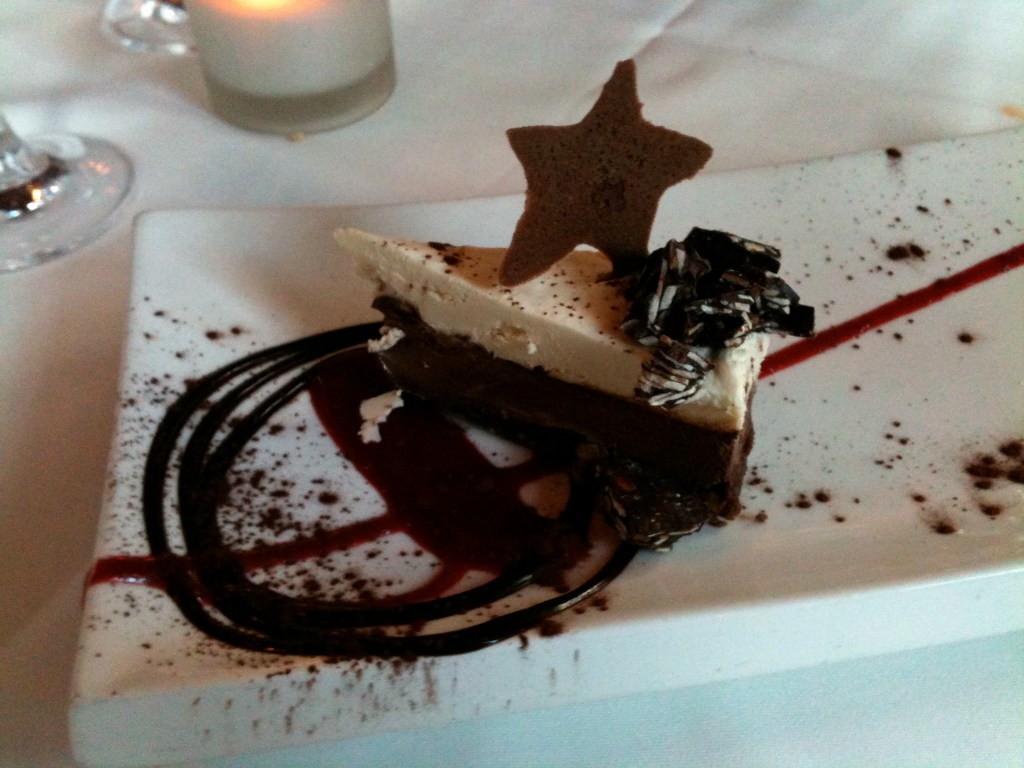
The menu was quite extensive, but after some serious perusing, we settled on appetizers. My uncle had the Crusted Oyster Mushrooms, breaded in rice and sesame flour and deep fried, which looked like calamari and were deliciously crunchy. He was a little disappointed because they didn’t taste very mushroom-y, so maybe breading and deep-frying wasn’t the best treatment for something as subtle as an oyster mushroom.My aunt had a black bean and caramelized plantain torte.I had the Chickpea Panisse: a chickpea purée with a firm, almost custard-like texture that was panfried like polenta and served with sautéed mushrooms, onions, raisins, and spiced almonds on top and a roasted garlic-cashew cream sauce underneath. I love chickpeas so this was an easy choice for me. Yummy.Next up were the entrées. My uncle continued with the mushroom theme and got the Huitlacoche Tamale, but again found that the mushroom flavour wasn’t as prominent as he was hoping for.My aunt had a coconut curry dish that she said was full of very interesting flavours.I had the Brick Pastry, which turned out to be a strudel-like construction of very thin pastry rolled around a filling of seitan, sautéed chard, potatoes, and mushrooms, served over black lentils, green beans, and mushrooms, with a red currant sauce. It was delicious. I’d never had seitan before, and the flavour was quite strong, but still tasty, and the whole thing was balanced really nicely by the acidity of the red currant sauce. And the lentils were awesome – they were almost my favorite part (I never thought I’d say that about lentils!).Then my aunt and I shared a dessert. This one was seriously mind-blowing: you would never guess that it wasn’t packed full of dairy and eggs. We had the Chocolate Midnight, which was white chocolate and dark chocolate-mocha mousse on a chocolate nut crust with raspberry sauce. Absolutely to die for.Their dessert menu was perhaps the most impressive, because it was all egg- and dairy-free but they still managed to make several kinds of ice cream. Our server told us they use different bases of coconut, almond, rice, and soy milks, and somehow they can even make a dairy-free, vegan “buttermilk” ice cream! I want to go back just to try all their desserts.

This was a really impressive meal and a great example of amazing food – vegetarian, vegan, or otherwise. I didn’t even notice that there wasn’t any meat in my meal, and I certainly didn’t miss it! If you are in San Francisco, definitely give Millennium a visit – try the ice cream and report back to me!

Millennium on Urbanspoon

Cream Cheese Swiss Meringue Buttercream: An Exercise in Perseverance

5 Aug

Not the most attractive photo…

*** UPDATE: CLICK HERE FOR A NEW METHOD THAT ACTUALLY WORKS!!

** EDITED TO ADD: After having frosted the wedding cake using this frosting, I have to say that I do not recommend this recipe – it just plain did not work very well and was extremely hard to work with, unfortunately :( I almost want to take down the recipe, but this was a pretty epic post and I’m kind of proud of it, so I’m going to leave it. The frosting tasted awesome (like liquid cheesecake – emphasis on the liquid) but it would not thicken up enough to spread easily; it would not un-curdle no matter how long I stirred it, chilled it, or left it at room temperature; and it was so soupy that I had to frost the cake in several coats, chilling between each coat to build up the frosting layer. And because it was curdled, it didn’t have a smooth finish (which was OK because the look of the wedding cake was kind of rustic, but it was still annoying). Bottom line: cream cheese has too much water in it to make a proper Swiss meringue buttercream, which relies on the high fat content in the butter to emulsify with the egg whites. If you’re looking for a cream cheese Swiss meringue buttercream frosting recipe, check out this one – it works around the cream cheese/high water content problem.**

Alternative titles for this post:

Zen and the Art of Cream Cheese Swiss Meringue Buttercream

or

Testing Your Patience with Cream Cheese Swiss Meringue Buttercream

or

How to Give Yourself Gray Hairs and an Anxiety Disorder

So. After the wedding cake trial I did a while back, I discerned that I needed to find a cream cheese frosting not made with confectioners’ sugar – more specifically, that I wanted to make a Swiss meringue buttercream frosting with cream cheese. A quick Google search turned up a recipe for Cream Cheese Swiss Meringue Buttercream, and lo and behold, this very frosting had been used on a wedding cake! Double score!!

For those who don’t know, a Swiss meringue buttercream frosting is made by beating butter into a whipped meringue base of egg whites and sugar (heated to 140˚F to make them safe). I was a bit apprehensive at the thought of this, mostly because of the amount of egg whites that are required (being that I’m on a budget, and egg whites are more expensive than confectioners’ sugar). However, this frosting is seriously delicious – creamy, light, buttery, and not overly sweet; basically it blows any confectioners’ sugar frosting out of the water – so I was willing to overcome my initial qualms in favour of deliciousness. I had made Swiss meringue buttercream once before, back when I was in high school, and I don’t remember it being terribly difficult or onerous – I was only about 16, so it can’t have been *that* hard – but I had also read a few posts about how this type of frosting can be the most demoralizing endeavour because it just. won’t. come. together, and I knew I needed to do a test run.

I scaled down the recipe to use only 1 egg white and got down to business. A full 3 hours of beating/whisking/stirring later, I still had soupy, curdled glop (albeit delicious, cheesecake-flavoured glop). I was reluctant to give up, because this recipe and all others I had read tell you to just keep beating it and not lose hope – it will eventually work out. But I had to go to bed, so I declared this small test batch a failure. I did not, however, lose faith in the recipe or the method: I figured that the amount was too small, that the beaters of the KitchenAid weren’t able to get into the mixture far enough to really do anything, that it was just too hot in the kitchen and the butter and cream cheese were melting. I made plans for a second test run with a slightly larger batch.

At this point, I got a few tips from Jackie of Foodology, including a link to Sweetopolita’s post Swiss Meringue Buttercream Demystified. Reading this helped a lot, and introduced the idea of chilling the mixture when it gets too soupy. I started on the second test batch with renewed hope and things went marginally better – however it was really hot in the kitchen (mid-day at the end of July) so I had to alternate between bouts of chilling and beating the tar out of the frosting in the KitchenAid. And finally, over two hours later, it started to come together. Whew! Up until this point, I was planning on making the frosting in Vancouver, but now I decided I was going to make it beforehand and just refrigerate it, because if it didn’t come together when I needed it to, I would seriously lose it.

So, based on all I had learned, I made a larger batch (half of what I needed in total, to accommodate the size of my mixer), starting early in the morning to avoid the hot kitchen issue. You are supposed to let your butter/cream cheese come to room temperature, but I decided not to let either get too soft, thinking that the heat of the kitchen would be less of an issue that way. I whipped up the meringue, beat in the butter and cream cheese, and then set the mixer on high to do its thing. And two hours later, nothing. Still a curdled mess. I took the whisk attachment off the mixer and half-heartedly stirred at the frosting by hand a few times – and EUREKA! With slow stirring, the frosting somehow started to come together in a thick, fluffy mass. I put on the paddle attachment and turned the speed to low, and a (long) while later, I had proper frosting!! But seriously, it still took all bloody day. And I still had another batch to make.

But now I *finally* had it figured out. While the previous batch was going, I read this Swiss meringue buttercream tutorial and had two more epiphanies: 1) beat the egg whites until stiff peaks form; and 2) once the butter is added, stir on low speed with the paddle attachment. I had sort of figured this out for myself, but this was the first time I had actually read that SLOW SPEED was the important thing here (I don’t know if I just missed it in all the other tutorials I read, or what). The fourth time is apparently the charm, or maybe I was just used to it, because the frosting came together fine – but it still took over an hour of stirring!

If you’re still reading, you’re probably wondering why the heck I went to all this trouble to make this particular frosting. The answer is that is it freaking delicious – it tastes just like cheesecake without being sickly sweet. Nate watched me make this frosting four times and thought I was crazy because of how long it was taking, but then when he tasted it, he said, “Now I know why you persevered.” It’s that good. So here is the recipe, along with all my tips for making it. Continue reading 

Cake for 60

3 Aug

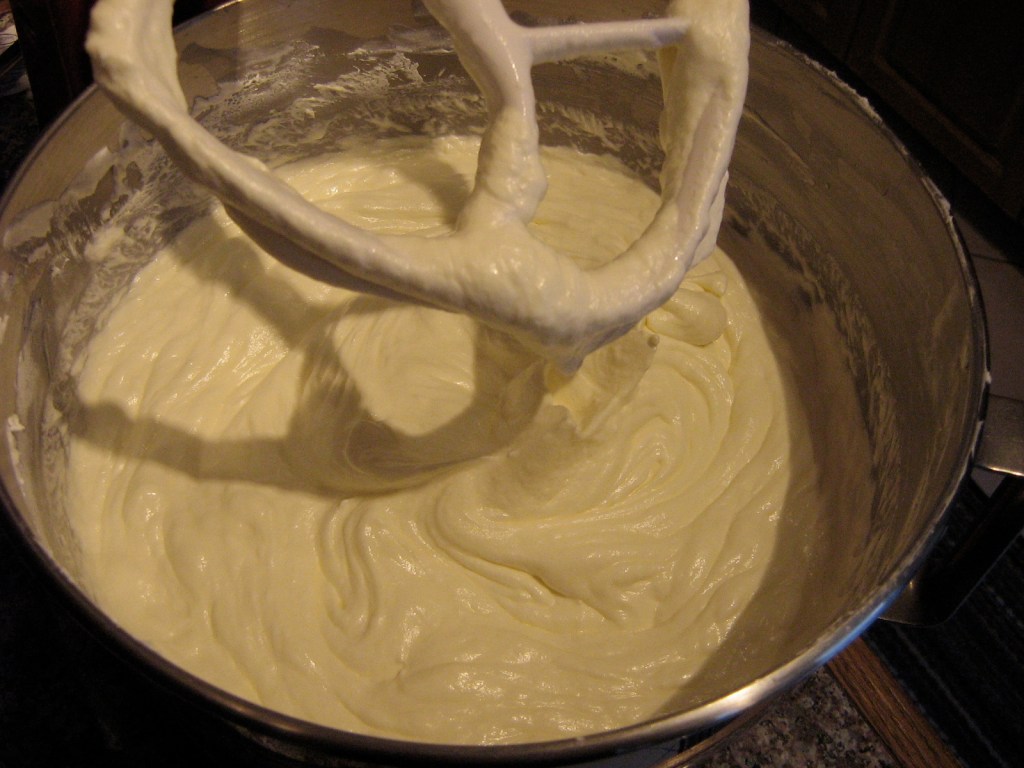
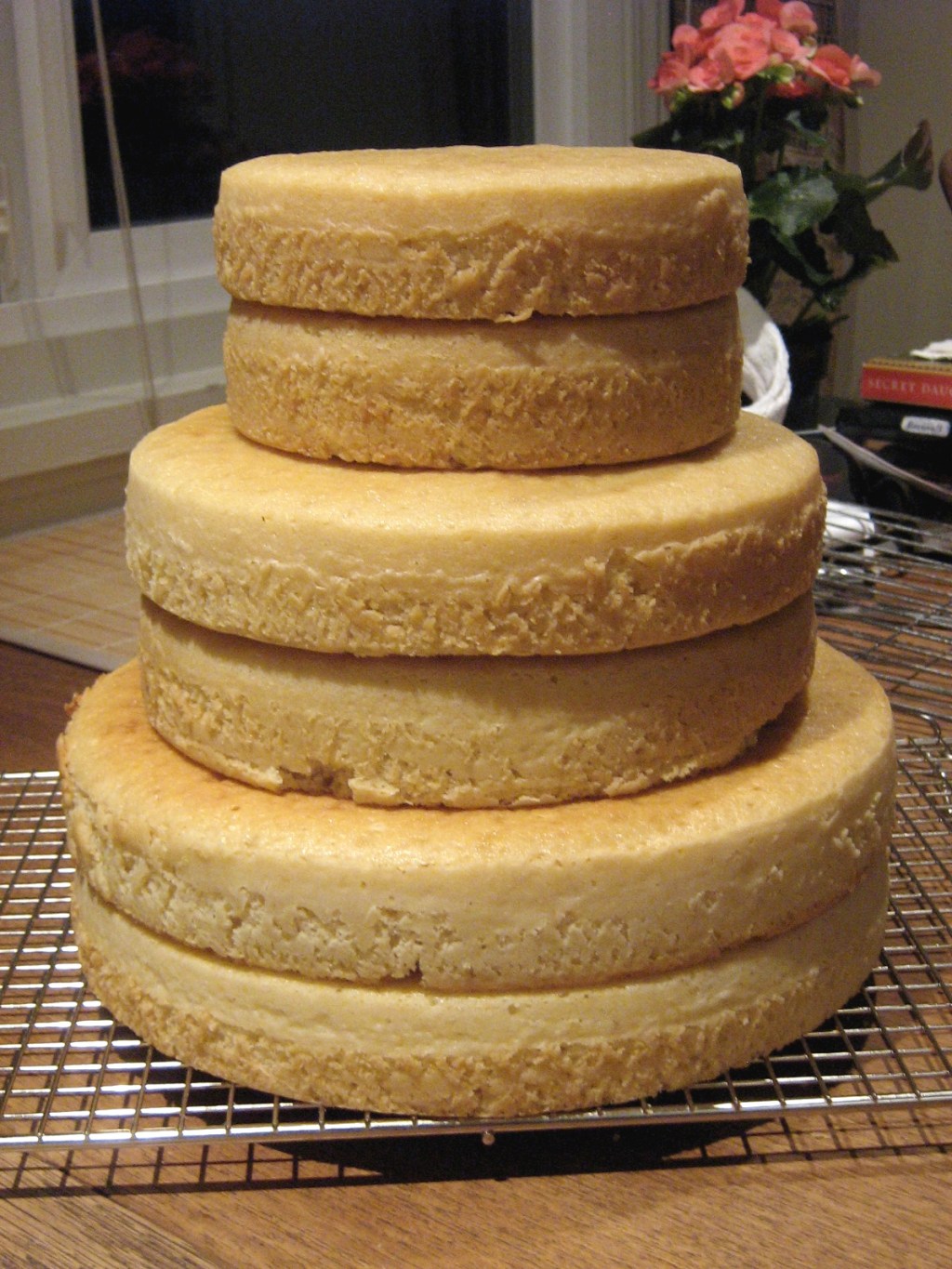
My friend’s wedding is coming up this weekend, so the cakes were baked last week and are happily camping in the freezer, wrapped in plastic and tinfoil, awaiting transport to Vancouver in a few days. Baking the cakes was something I was a little worried about, despite the relative success of the trial run – would they bake evenly, would I have enough batter, would they taste good enough? Turns out all my fears were totally unfounded: the cakes turned out perfectly. They baked in flat, even layers (thanks so the wet towel/cake diaper trick) and they all baked in exactly 50 minutes, no matter which pan size. Even the big 10-inch baked evenly all the way to the middle without a heating core or anything.Remember the confidence I had in my math skillz when I calculated how much batter I would need and how I would need to scale the recipe? I was fairly sure that I would end up with just shy of the right amount of batter, but I got that part totally wrong: I ended up with about 2 cups of extra batter, which is definitely better than 2 cups too little! This meant that I got to use the extra batter to make these sweet little shell-cakes:I made one-and-a half times the original recipe and ended up with about 16 1/2 cups of batter, enough for two 10-inch, two 8-inch, and two 6-inch rounds, each 1 1/2 inches high when baked, plus a bunch of little shell cakes ;) I mixed the batter in three batches (a half recipe each), then mixed them all together in one big bowl to make sure the batter was uniform. Some of the batter sat for quite a while because I could only bake two cakes at once, and I was concerned that the baking powder and baking soda would lose their leavening power before they hit the oven, but it didn’t seem to make any difference :) Success! Continue reading 

Follow

Get every new post delivered to your Inbox.

Join 579 other followers