My recent trip to Pacific Grove/Monterey, California, to visit my aunt and uncle contained horrific travel (delayed flights resulting in missed connections in both directions, leading to one miserable overnight in the San Francisco airport on the trip down and another 8 hour “layover” in the same airport on the way home. Plus the airline lost my luggage. A word of advice: don’t fly United!) and amazing restaurants. The day after I arrived, we drove up to San Francisco for a day of shopping (I needed a dress for the wedding I’m making the cake for
) and eating: we had lunch reservations at the Zuni Café, and dinner reservations at Millenium Restaurant. Both were highly anticipated, and I was pretty excited.
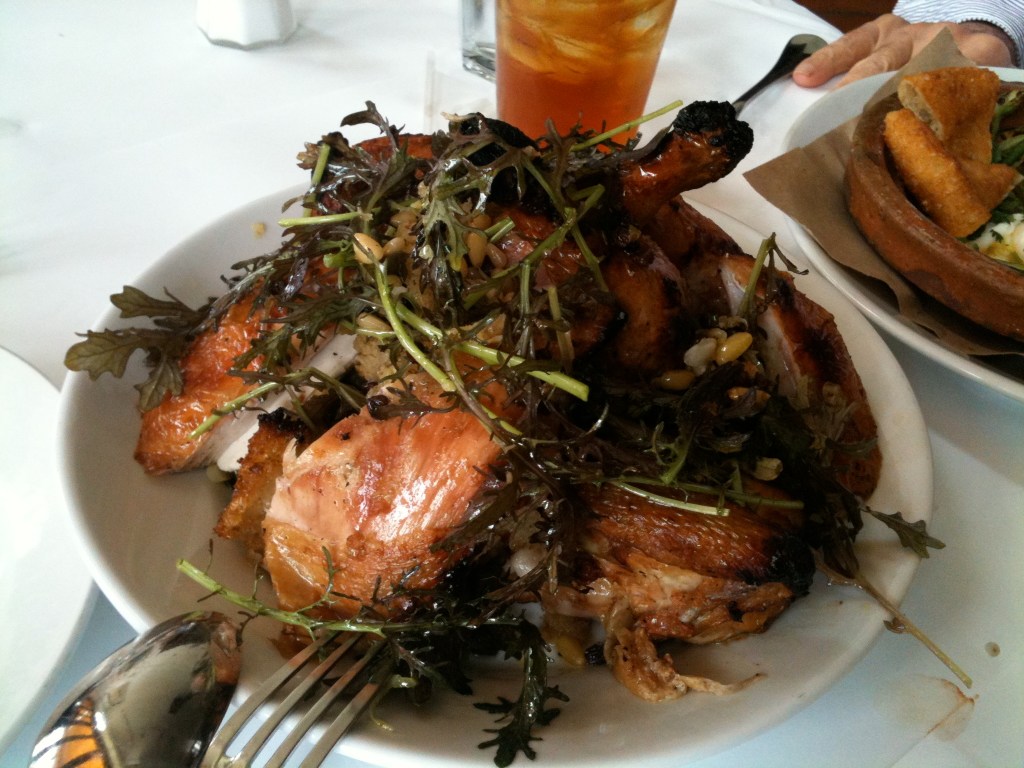
The Zuni Café is an award winning restaurant that has been around since the late 1970s (in a slightly different incarnation than it is now, involving a Weber grill and espresso machine that also doubled as an element to scramble eggs on?!) and as such is pretty well-known (at least in the San Francisco food scene, of which I am not a part!). In addition to their focus on seasonal ingredients from sustainable sources, and one of the things the restaurant is known for is their wood-burning brick oven, which is smack-dab in the middle of their open kitchen. They bake their own bread in that oven, and they also do a whole roast chicken, served on top of a bread salad, which has a reputation for being awesome, which is why we ordered it. But I’m getting ahead of myself. Continue reading
Eating Out in San Francisco, Part I: Lunch at the Zuni Café
29 JulDaring Bakers: Fresh Fraisier
27 Jul
Jana of Cherry Tea Cakes was our July Daring Bakers’ host and she challenges us to make Fresh Frasiers inspired by recipes written by Elisabeth M. Prueitt and Chad Robertson in the beautiful cookbook Tartine.
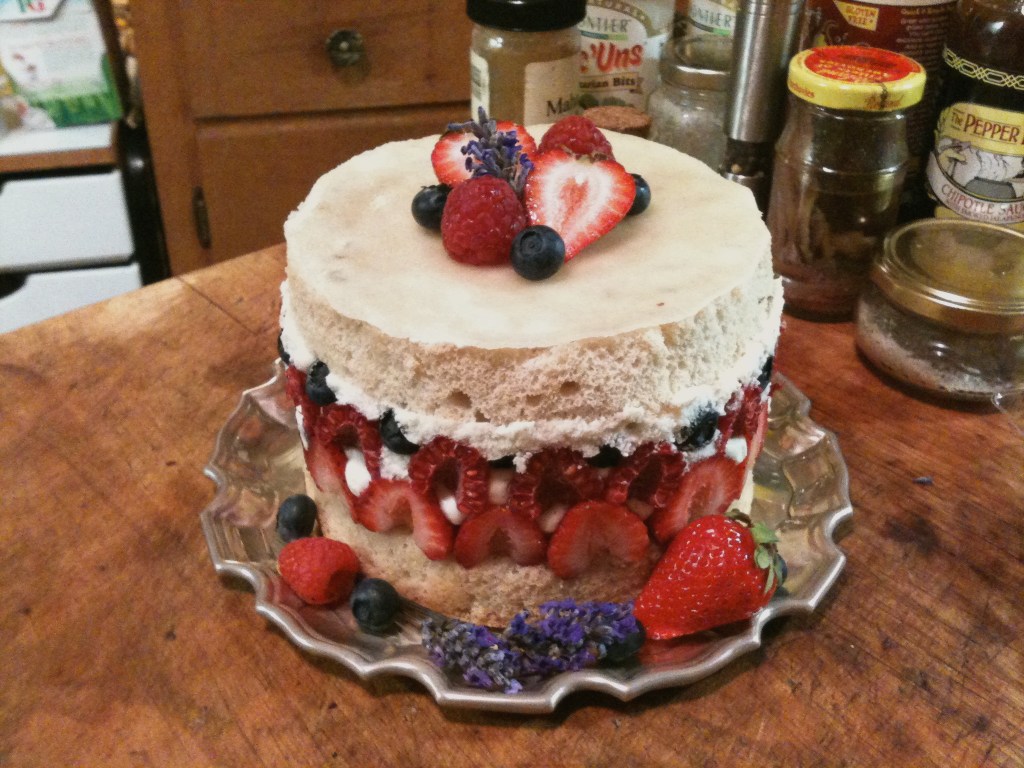
A fraisier is a French pastry consisting of two layers of cake soaked in simple syrup with strawberries and pastry cream sandwiched between. Essentially, it is a free-standing trifle, but the special thing about a fraisier is the exposed fruit around the sides. To make a true fraisier, you have to use strawberries (fraise = strawberry), so I’m not really sure what to call my strawberry-raspberry-blueberry combination – a baies mélanger-ier doesn’t really have the same ring to it. But whatever you want to call it, it was tasty!
I did this challenge while I was in California visiting my aunt and uncle, and it was extra challenging because I was baking in an unfamiliar kitchen and also contending with a wheat and corn allergy. But it turned out beautifully and just proves that you don’t need fancy equipment or lots of space to make a spectacular dessert.
Jana gave us lots of freedom with the flavours in our fraisiers – the only caveats were that it had to include cake, cream, and exposed fruit around the sides. I knew I wanted the berries to be the star of the dessert, so I shrugged off my initial reaction of “OMG chocolate everything!!!” and went instead with floral flavours. I used lavender sugar to make the chiffon cake and simple syrup, and I used vanilla bean in the pastry cream for an extra vanilla hit. By happy accident, my aunt didn’t have any regular sugar so I ended up also using honey in the pastry cream, which turned out to be an awesome flavour along with the vanilla and lavender.To make the cake wheat-free I used a gluten-free baking mix from Bob’s Red Mill. The pastry cream called for corn starch, and I wanted to replace it with tapioca starch, but I couldn’t find any in the grocery store. Instead, I used regular tapioca granules – the kind used for making tapioca pudding. This only sort of worked: it thickened up nicely, but it had the little tapioca pearls in it (the texture of which totally puts me off
) so I sieved the pastry cream to remove them, and ended up with not quite enough pastry cream. It worked out in the end, but lesson learned: tapioca for pudding is NOT the same as tapioca starch! (Also FYI, the little tapioca pearls, when dry, are hard as rock and IMPOSSIBLE to crush!)
The finished dessert looked beautiful and tasted great, but if I were to make it again (which I probably will – it is a fantastic summer dessert with the airy cake, cream, and fruit) I think I would follow this recipe. Instead of using a chiffon cake (very small amount of oil in the batter), this other recipe uses a génoise cake, which contains butter, giving it a slightly more substantial crumb. The pastry cream is also quite different: it is actually a crème mousseline, which doesn’t use gelatin, contains more egg yolks, and seems like it would taste a little more like crème anglaise, which I like. However, this Daring Bakers Challenge introduced me to a great new form of dessert, and the chiffon cake recipe is awesome!! Thanks, Jana, for hosting this one! Head on over to the Daring Bakers website to see all the other beautiful fraisier creations this month – there are some seriously gorgeous cakes!
PS – If anyone knows what you would call a “mixed-berry fraisier” in French, please enlighten me! Continue reading
Dobos Torte Birthday Cake
21 Jul
I’m back from California, and after I recover from the travel part (which was horrendously awful) and get a chance to go through all the photos I took of food, I’ll have some posts about the awesome restaurants I visited in California… but in the meantime, you can hear all about my birthday cake
I turned 28 a few weeks ago, and it required a cake. Since baking is pretty much my favorite pass-time, I was more than happy to bake it myself – it meant I got exactly what I wanted and I also got to have the fun of doing it. I came across this recipe for Dobos Torte on Smitten Kitchen, where Deb had made it for her own recent birthday, and I immediately promised I’d make it for myself. So I did
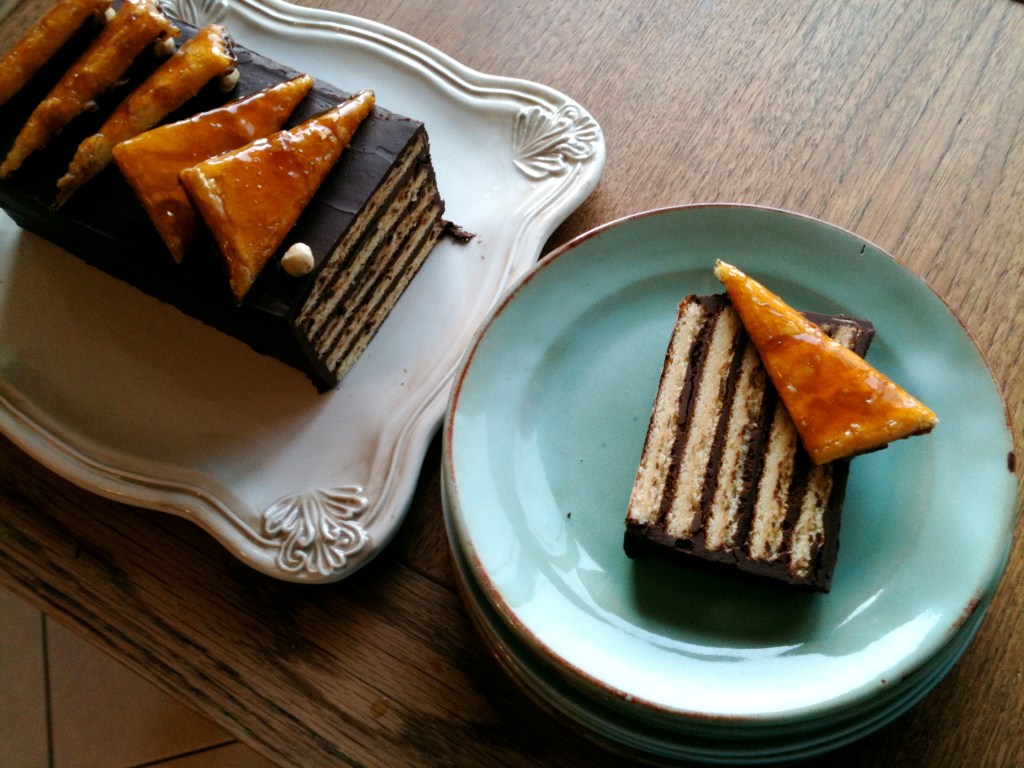
A Dobos Torte is apparently Hungarian in origin, and is composed of layers of thin sponge cake filled and frosted with creamy, buttery, chocolate frosting. What makes it really fancy-looking (in addition to the striped layered effect you get when you slice it) are caramel-covered sponge cake pieces on the top of the cake. It didn’t really do a lot for me flavour-wise, but it looked really cool and the crunchy hard caramel was a nice contrast from the soft spongy cake and rich creamy frosting.
I served this to a bunch of friends and it got huge rave reviews, including, “This is the best cake you’ve ever made!” It very well might have been – it was seriously delicious. The cake was sweet but not overly-so, and the frosting was like I’d dipped the cake in chocolate truffle. And it wasn’t that hard to make, either. You can bake the entire thing in one large pan, then cut it in pieces, layer them up with frosting, and top it with the caramel. The original post on Smitten Kitchen gives a bunch of variations on pan size and shape, so head on over there if you’re interested. I used a 12″ x 17″ pan and cut the cake into six pieces – five layers inside the cake and one caramel layer on top.
Dobos Torte
Recipe from Smitten Kitchen (adapted from Great Book of Desserts by Maida Hedder; caramel layer and tips from Joe Pastry). See the Smitten Kitchen post for other pan sizes and shapes.
Makes one 8″ x 3″ x 4″ rectangular cake, about 10-12 servings (thin slices are plenty!)
Note: this recipe requires 13 eggs total (separated into 13 yolks and 7 whites)
The Batter:
Preheat the oven to 450˚ F and place a rack in the center. Line the bottom of a 12″ x 17″ sheet pan/jelly roll pan with parchment paper, then butter and flour the whole thing. Set aside.
10 egg yolks
3 1/2 cups confectioner’s sugar
3/4 cup all purpose flour
1/8 tsp salt
1 tbsp lemon juice
7 egg whites
In the bowl of an electric mixer with the whisk attachment, beat the 10 egg yolks on high speed until thick and lemon-coloured.
Beat in the confectioner’s sugar, little by little, starting at low speed and increasing to high.
Add in the flour and beat on high, stopping occasionally to scrape the bowl. The texture of the batter will change from nice and creamy to the approximate texture of drywall spackel.
Don’t worry, this is supposed to happen. Mix for 5 minutes, then beat in the lemon juice.
Clean off the whisk attachment very well and beat the 7 egg whites in a clean bowl until stiff peaks form. This may mean you have to scrape the spackle/batter into another bowl and wash the original one out very well (if there is any fat (ie, egg yolks) on the beater or in the bowl, the egg whites won’t whip up properly). Fold a few spoonfuls of the whipped egg whites into the spackle to lighten it – this will seem impossible, but have patience and keep folding.
Fold in the rest of the egg whites in 3 additions. I folded the first few additions in with a spatula, and the last few with a whisk. Your spackle should have transformed into a foamy batter.
Pour the batter onto the prepared pan and spread it evenly into the corners using an offset spatula.
Bake at 450˚ F for 5 – 9 minutes, until baked in the center and golden brown on top with some dark spots. When the cake is baked, dust the top with confectioner’s sugar and invert it onto a cooling rack. Lift off the baking pan (it might take a minute or two for the cake to peel itself out of the pan), remove the parchment paper, and dust the bottom surface with more confectioner’s sugar. Invert it again onto another cooling rack and let the cake cool.
The Frosting:
(Includes raw egg yolks, so if you’re worried, you can make a chocolate ganache frosting instead. It’s important to use 70% dark chocolate in the frosting so as not to overwhelm the cake with sweetness.)
1 cup butter, room temperature, cut into cubes
1/2 lb dark chocolate (min. 70% cocoa solids), chopped
3 egg yolks
1 tsp vanilla extract
2 tbsp confectioner’s sugar
Melt the chocolate until smooth and set aside to cool. In the bowl of an electric mixer with the paddle attachment, beat the butter until creamy. Add the egg yolks and vanilla, then the chocolate and confectioner’s sugar, scraping the bowl as needed.
Beat on high for several minutes until lighter in colour and very creamy.
To Assemble:
When the cake is cool, trim the edges, then cut it in half lengthwise. Cut each half into three rectangles to get six pieces (I used a tape measure to be as accurate as possible).
Reserve the most unblemished piece for the caramel layer. Protect your serving plate with four strips of waxed paper, and lay the first cake layer on top. Spread it thinly with frosting, right to the edges (about 1/4 – 1/3 of a cup is good).
Repeat with the remaining four layers, then frost the top and sides of the cake with a thin layer of frosting to seal in the crumbs.
Refrigerate the cake for about 30 minutes to set the crumb coat, then spread the outside with the remaining frosting.
The Caramel Layer:
Lightly grease a piece of parchment paper and place the last piece of cake on it. Grease an offset spatula and the blade of a large chef’s knife. Set aside.
1/2 cup granulated sugar
1 tbsp water
Combine the above in a small, heavy sauce pan and heat over medium-high to high heat, swirling the pan constantly. The sugar mixture should be bubbling. Keep swirling until it turns a light amber colour, then, working quickly, pour it over the cake layer on the parchment paper (you might not need all of it).
With the greased offset spatula, spread the caramel to cover the whole piece of cake, then let it set for a few seconds. Cut it into wedges with the greased chef’s knife, and let it cool completely.
Cut it again and clean up the edges. Place the wedges decoratively on top of the frosted cake, propped up on toasted hazelnuts.
Chill the cake until ready to eat. If you want to cover it (lightly) in plastic wrap, place a sheet of waxed paper or parchment paper over the caramel pieces first, otherwise they will stick to the plastic. Cut in 10 – 12 thin slices to serve.
Wedding Cake Trial!
11 Jul
I finally got the replacement power cord for my computer so I can post about the wedding cake trial run I did a few weeks ago – yay!
First of all, cake size: there are about 55 guests at the wedding, so I’m making a three-tiered cake with 10-inch, 8-inch, and 6-inch round tiers, each about 4-inches high. I used the Wilton party cake serving guide and Earlene’s cake serving guide to come up with those sizes, which should yield about 60 pieces of cake (including the top tier, which will be eaten at the wedding rather than being saved for the bride and groom’s first anniversary). Wilton’s wedding cake serving guide gives much smaller servings, so I opted for larger pieces and slightly more cake than might be needed, to be on the safe side.
Based on the comments from the post where I asked for advice on which flavour to make the cake, the lemon cake with raspberry filling and cream cheese frosting is the clear winner! This was actually the combination I was going to go with in the first place, so thanks for validating my choice! So, now that my paralysing indecision was dealt with, I had to actually choose recipes for a lemon cake, raspberry filling, and cream cheese frosting, and then do a test run to figure out recipe yields and make sure they came out alright and tasted good!
After looking at dozens of cake recipes, I finally settled on a lemon butter cake from Margaret Braun’s book Cakewalk (she did the swirly yellow and white cake from my previous wedding cake post). I chose this recipe because she uses it for stacked cakes, so I know it will hold up, and also because it doesn’t require whipping egg whites separately, which is time consuming.
I halved the recipe to make two 6-inch cakes, and ended up with 4 3/4 cups of batter, which turned out to be more than enough (I’ll need two cakes to get the 4-inches of height). I took some advice on baking a level cake from i am baker and sacrificed a towel to cut into strips to wrap around the pan before baking.
This is supposed to act as insulation and stop the edges of the cake from baking faster than the middle, thus preventing a domed top (which has to be trimmed off when stacking the layers, meaning you’re wasting a bunch of cake). As you can see, it didn’t really work. Later I realized that the towel strips are supposed to be wet, so I’ll give that a try when I bake the cakes for real! (Also, doesn’t it look like the pan is wearing a diaper?)
Anyway, using the amount of batter suggested by Wilton, I baked the first cake with 2 cups of batter and it rose up in a dome about an inch higher than the pan, which meant I would have to slice off a bunch from the top, so I scaled back on the second cake to 1 1/4 cups of batter. This one baked in a shorter amount of time so it didn’t get the same golden crust as the first one, but it didn’t overwhelm the pan and I wouldn’t have to trim as much off the top.
Based on this second cake, I calculated that I will need about 14 1/2 cups total for all the cakes, which is one and a half times the original recipe (or three half-batches, which will be easier for my mixer to handle!). Doing this required all of my math skills and I definitely can’t explain how I figured it out, but it does make sense. Thank goodness for calculators! Math problems aside, the cake itself tasted really good, with a pound-cake like texture (firm rather than airy) and a nice moist crumb. I will add a bit more lemon juice and zest next time though – it could have been more lemon-y.
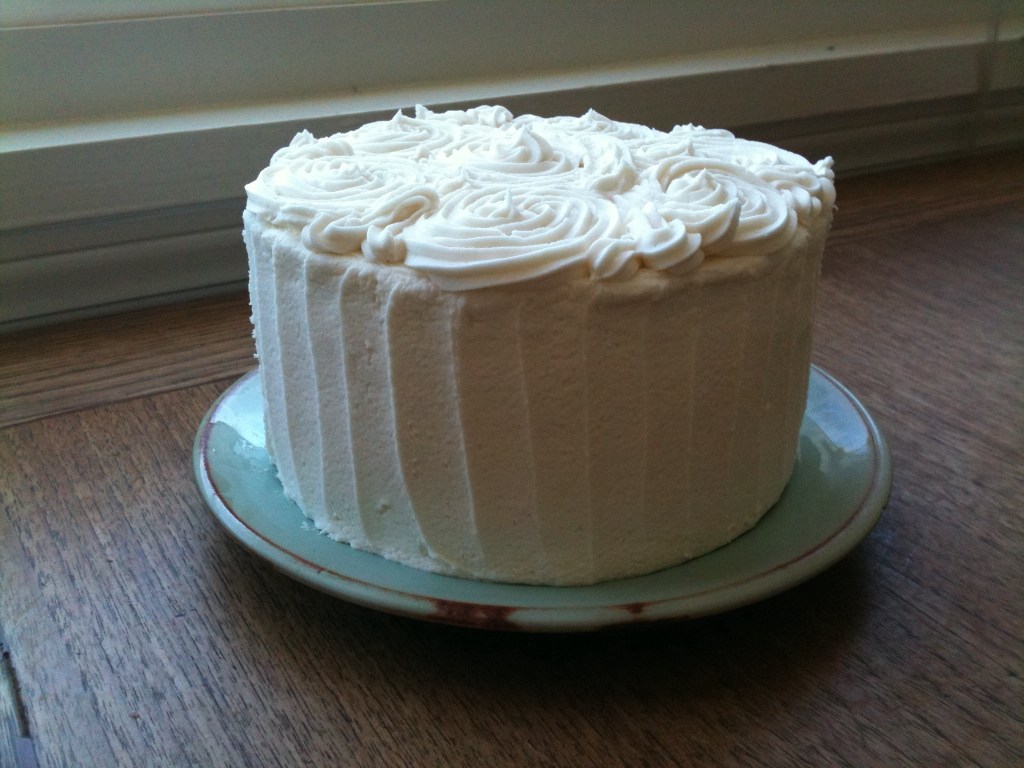
The frosting: cream cheese frosting is usually quite soft and heavy and not exactly fluffy, so I spent a long time looking for a recipe that would give me something both spreadable and light, but that would also be able to sit unrefrigerated for a while and not lose its shape. I found this recipe for Professional Cream Cheese Buttercream Frosting, and the only thing that I wasn’t sure about was that it contained shortening. I know that lots of decorators use shortening-based frostings because they are light, fluffy, pipeable, and hold up well at room temperature, but I’ve never even bought shortening (ie, Cristco) before, so I was wary. I made a quarter batch for this 6-inch cake, which gave me 2 2/3 cups of frosting. I liked that it got really firm in the fridge, which would make moving and stacking the cakes easy, but it was not as fluffy as I wanted and WAY too sweet. Upon further research, apparently this is usually the problem with confectioner’s sugar-based frosting, so I’m going to try a cream cheese Swiss Meringue Buttercream frosting instead, like this one. This method sort of scares me but I think it will taste much better, so I will just have to get over my fear!
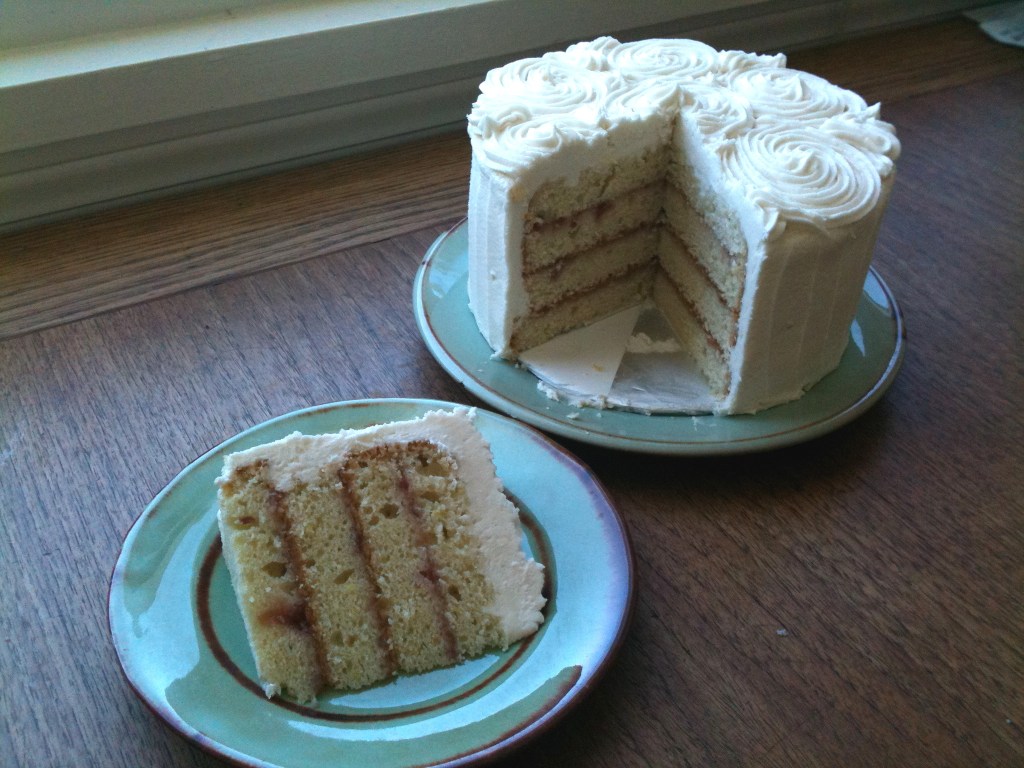
I got the idea for vertical stripes on the sides from i am baker. The swirly stuff on top was just me trying to use up the rest of the icing (actually I was trying to do this, but I failed. Among other things, my star tip was too small!)
I used store-bought raspberry jam to spread between the layers, because I figured that making my own jam or filling would be too difficult, but now I’ve changed my mind. The jam was not quite raspberry-ey enough, so I’m going to try a no-cook freezer jam recipe instead, which is essentially just mashed berries with sugar and pectin. Hopefully this will result in a suitably rasberry’d filling!
I also made a simple syrup of sugar, water, and lemon juice and zest to sprinkle on the cake layers before spreading them with raspberry. This tasted great and helped keep the cakes moist.
And finally, the cake base: my trusted friend Martha suggests that you can use regular 3/16-inch foam-core board to put the cakes on, which I did, but I covered it in foil because I wasn’t sure how well cake and paper go together. The foil was a bad idea though, because when I cut the first slice of cake it came off with a chunk of foil stuck to the bottom. Now I don’t know if I should buy real cake boards from a bakery, or just use the foam core au naturel, as Martha suggests…
So, the plan: I will bake the cakes ahead of time and freeze them, then fill/frost/assemble the cake the day before the wedding. I will add more lemon to the batter, be careful about sifting and not over-beating, and use wet towel strips when baking in hopes of ending up with a level cake. I still need to try the cream cheese Swiss Meringue Buttercream frosting, and make the raspberry filling. Figure out what to do about the cake base. Oh, and did I mention I need to transport all of this plus equipment on the ferry from Victoria to Vancouver and assemble it in my grandparents’ kitchen before moving the cake to the venue?? Did I also mention how EXCITED I am about this?!?!
Here’s some helpful wedding cake-related links:
My trusted friend Martha puts together a tiered wedding cake from start to finish
A helpful video on how to get a smooth finish on a frosted cake
A really pretty decoration idea for a wedding cake
Cake and filling/frosting recipe ideas from Martha
Deb at Smitten Kitchen made a wedding cake for her friends: read about it here
PS: I’m off to California for a week to visit my aunt and uncle starting tomorrow, so I might not update again until I get back. Rest assured, however, that I will have lots of delicious things to write about!!
Cake Madness!
7 JulThe power cord for my laptop is busted and I’m waiting for a replacement to be shipped, so I have been unable to update the blog… Also the batteries in my camera died and I’ve been too lazy to replace them… However, I got this fancy iPhone which lets me both take photos AND write (short) posts, so here’s a teaser for what’s to come once my computer is back up and running
First of all, this week I did a small trial run for the wedding cake I’m making. The overwhelming majority of people voted for the lemon cake with raspberry filling and cream cheese icing, so that’s what I’m going with. There’s going to be a whopper of a post about this one, but here’s a picture in the meantime:
Also, today is my birthday, so I spent the day making myself a birthday cake – a Dobos Torte, to be precise. I first heard of Dobos Torte via the Daring Bakers and it was something I wanted to try, and then I saw this recipe on Smitten Kitchen (she made it for her own birthday) and it looked so good I knew I had to make it. A Dobos Torte consists of several layers of thin sponge cake spread with buttery, creamy, chocolatey frosting and topped with a caramel-sponge cake layer. I’m having some friends over for a birthday dinner tomorrow and I can’t wait to try the cake!
So that’s two cakes in a week, which works out to a lot of cake. Stay tuned for the details